
Specializing at École polytechnique: many paths and opportunities
Unlike the engineering programs at most other schools, studies at École polytechnique last four years. The fourth year is devoted to specialization, with these main options: (i) joining one of the state corps (the subject of a future article), (ii) continuing at a partner school (engineering degree or Grande École program), (iii) taking a master's or a PhD in France, or (iv) studying abroad.
This article covers the programs offered by partner schools and master's programs in France.
Partner schools: a mark of quality
Many grandes écoles now make a point of being an école d'application of École polytechnique, a sign of academic excellence. The status, historically held by the engineering schools of the Mines-Ponts exam, is opening up to a wider range of programs. The partner schools now include:
AgroParisTech
ENSAE Paris
Chimie ParisTech – PSL
Toulouse INP – ENSEEIHT
Grenoble INP – ENSIMAG
IFP School
ENSTA Paris
INSTN
Institut d’Optique Graduate School
ISAE-Supaéro
Mines Paris – PSL
École nationale des Ponts et Chaussées
Supélec (until its merger with Centrale Paris in 2015)
IMT Atlantique
Télécom Paris
HEC Paris (Grande École program since 2012)
ESPCI Paris – PSL (since 2014)
ENSA Paris-Val de Seine (since 2016)
Sciences Po (since 2018)
ENSTA Bretagne (since 2020)
CNAM-ENJMIN (since 2022)
Demand remains strong, with clear differences
Polytechniciens still value the programs of the partner schools, though some attract far more students than others:
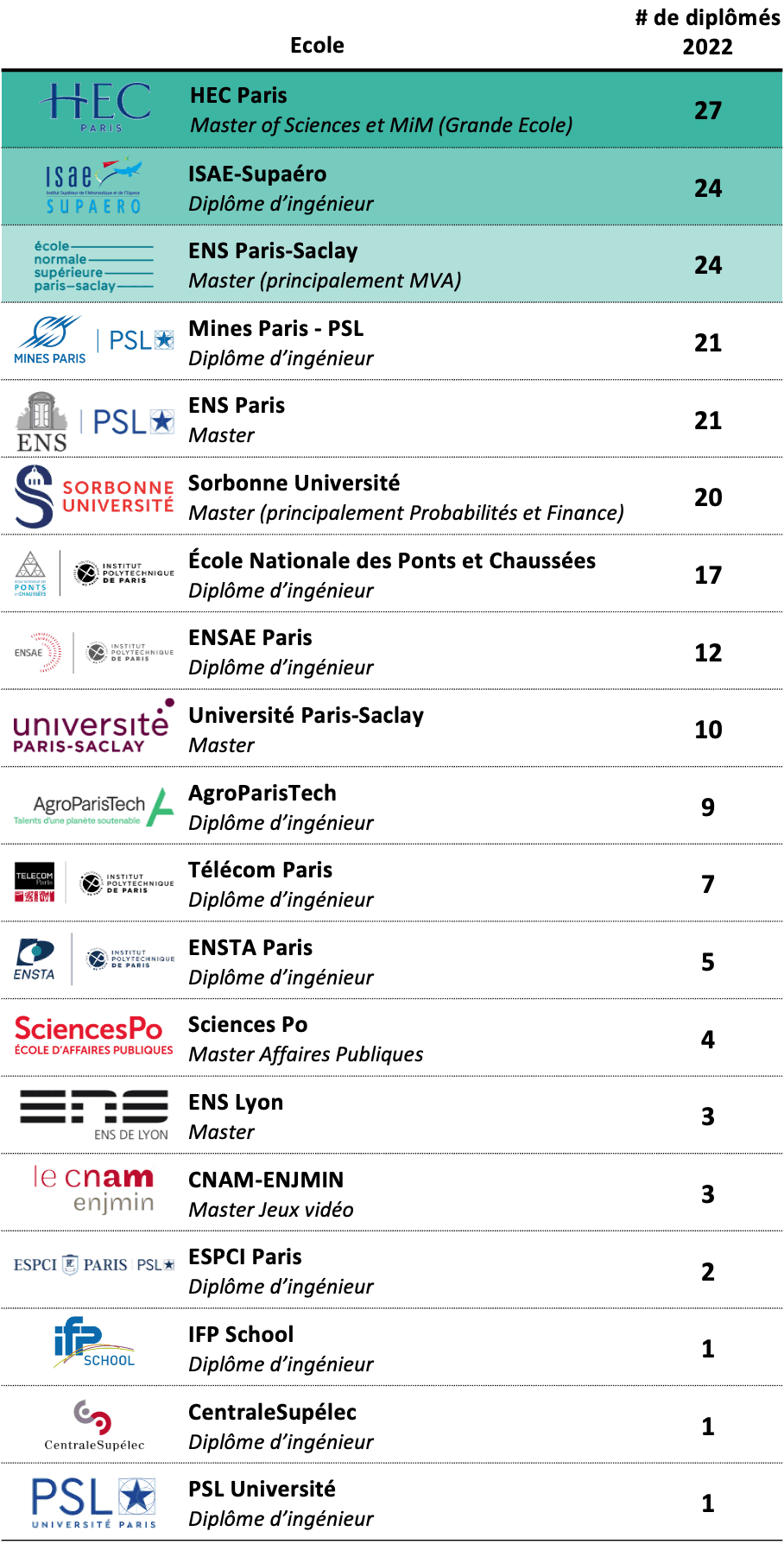
Nombre de polytechniciens ayant choisi une école d'application en 2023
At HEC Paris, students from École polytechnique mainly choose four programs:
The Grande École program (double degree since 2012), in which students choose a specific track.
The Master in International Finance, historically the most popular with polytechniciens.
The X-HEC Entrepreneurs master, run jointly by the two schools and focused on entrepreneurship.
The X-HEC Data Science for Business master, also run jointly, focused on data analysis.
Grandes écoles and the state corps
Many students at the partner schools come from the grands corps de l'État. For example, the Corps des Mines (10 polytechniciens) and the INSEE administrators' corps (9 polytechniciens) require the engineering degree of Mines Paris and ENSAE Paris respectively. The Corps de l'Armement and the Corps des Ponts, Eaux et Forêts are more flexible: students choose a partner school and follow a shorter corps training, six months at ENSTA Paris for the first and a Mastère Spécialisé shared between the École nationale des Ponts et Chaussées and AgroParisTech for the second. The schools these corps choose most are:
Mines Paris: (10 ICM, 2 IPEF)
ENSAE Paris: (9 INSEE)
ISAE-Supaéro: (7 IA)
École nationale des Ponts et Chaussées: (1 IA, 5 IPEF)
ENS Paris-Saclay – MVA: (1 ICM, 3 IPEF)
AgroParisTech: (2 IPEF)
The full data is summarized in the table below:
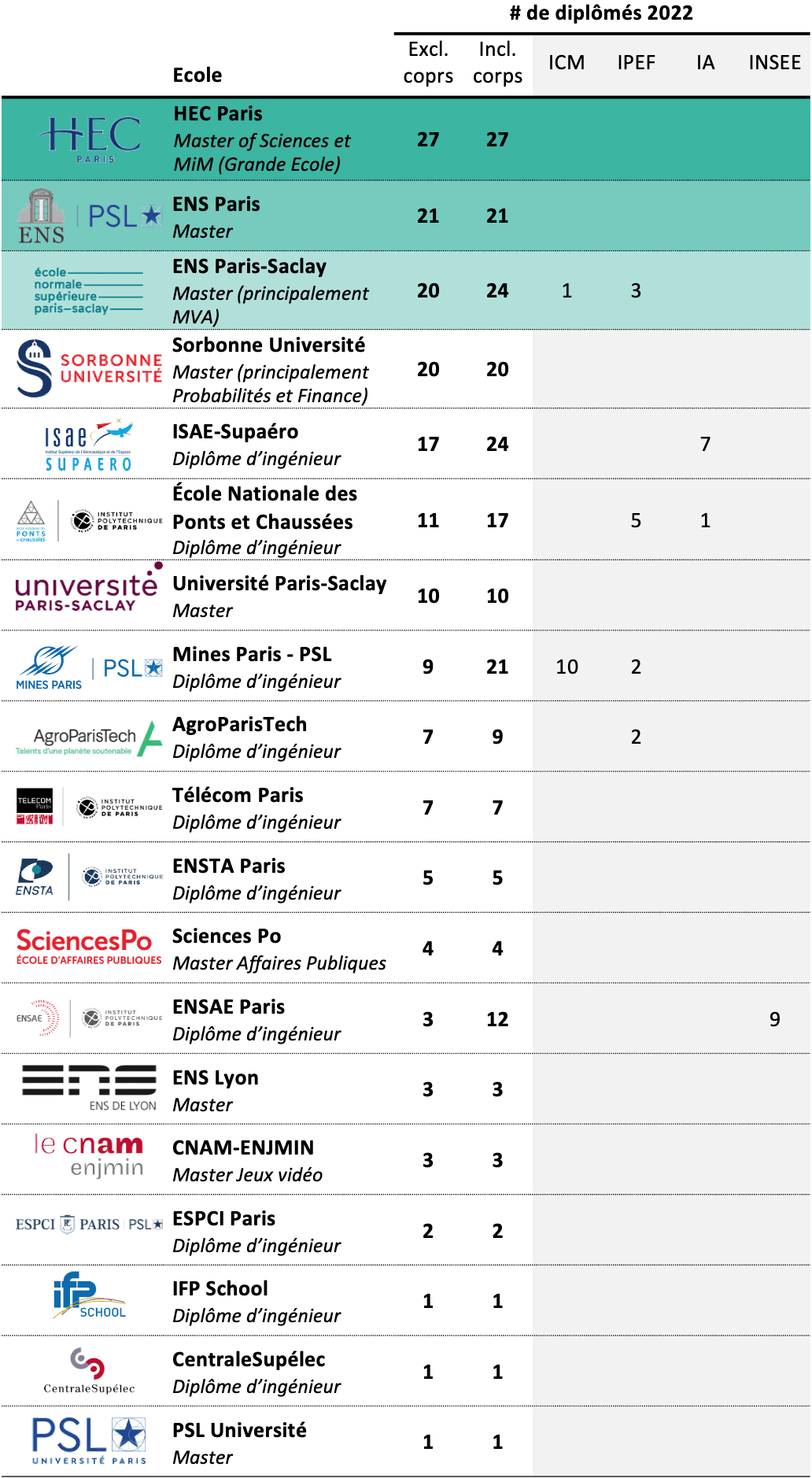
Tableau final de choix des écoles d'application avec le détail des corps