Most Concours Général awards go to a handful of Paris lycées, though the inequality varies by subject.
1. Awards are concentrated in a few lycées: 50% of the honorable mentions, accessits and prizes go to 17 lycées. In all, nearly 300 lycées, 9% of the total, shared more than a thousand awards over the last five years.
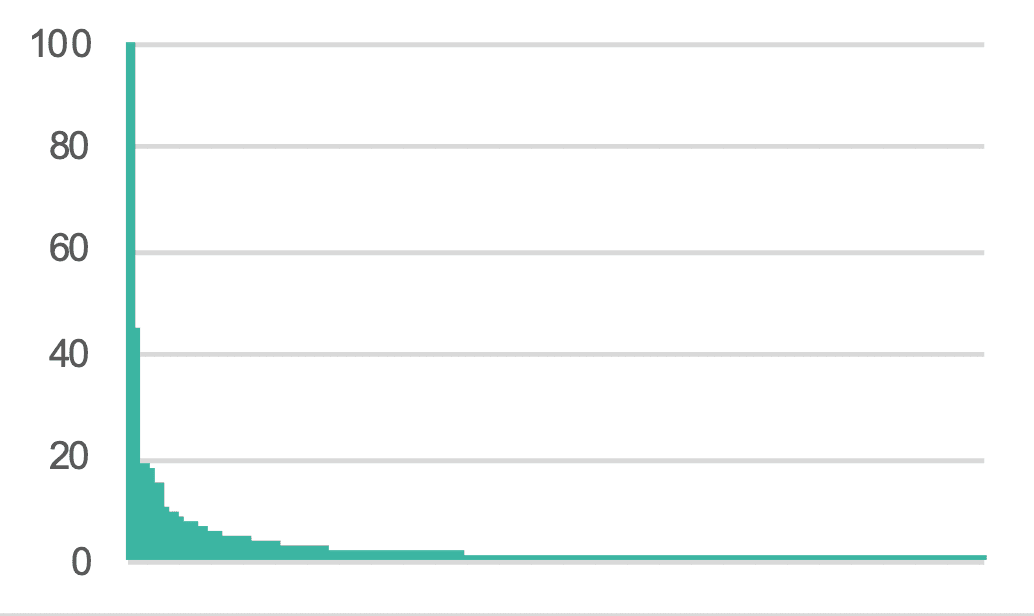
Le nombre de prix (absolu) par lycée est exponentiellement décroissant
Four lycées dominate the ranking of the schools that best prepare students for the Concours Général: Henri IV and Louis-le-Grand, followed by the Collège Stanislas and Saint-Louis de Gonzague. Their results are close to one another and well ahead of the rest. They rank almost every year as the top four lycées in France, though the order can change; the exception is 2015, when Stanislas and Saint-Louis de Gonzague dropped out of the top 4 while staying in the top ten.
The Franco-German lycée in Buc comes fifth in this ranking, but well behind the top 4 and with more uneven results from year to year.
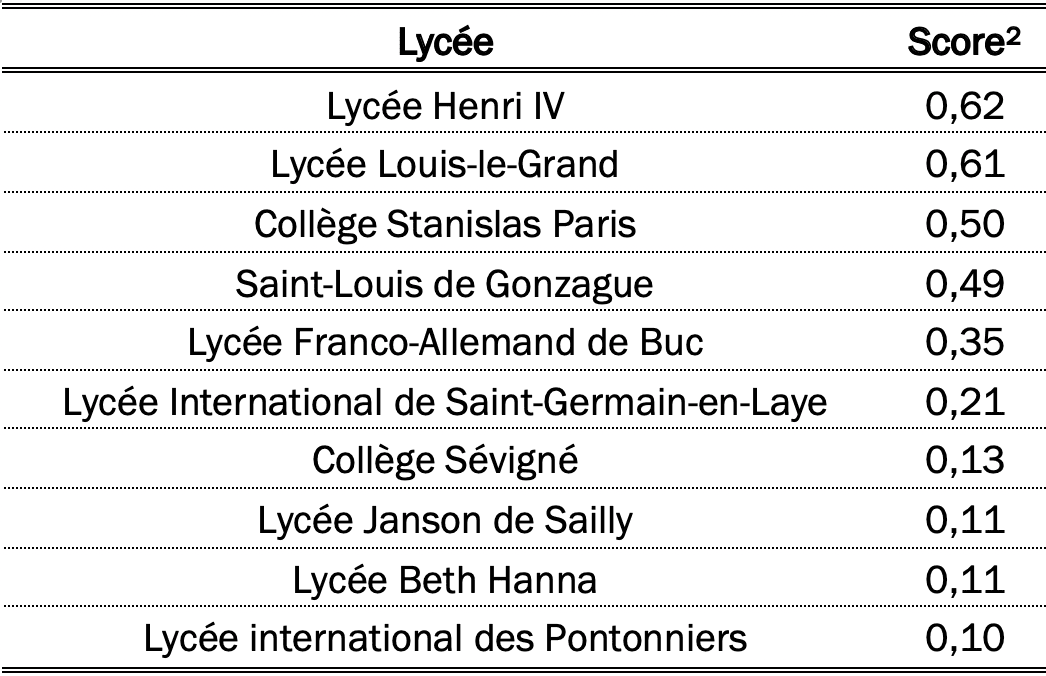
Classement des 10 meilleurs lycées en termes de préparation au concours général
The Concours Général calls for real preparation. Competition is fierce, with about 150 award winners on average out of 15,000 candidates chosen among the best students of every French lycée, and the tests are much harder than the baccalauréat. Depending on the test, the difficulty comes from (i) how little information and how few tools the subject gives, or (ii) topics outside the lycée curriculum.
In 2019, the physics and chemistry paper covered many topics outside the curriculum, and the philosophy subject was a single word: "Oublier" (To forget).
2. Private lycées win more than a quarter of the honorable mentions, accessits and prizes: they prepare their students better for the Concours Général. Only 17% of students attend a private secondary school, so private lycées score almost twice as high as public ones relative to their number of students. The ratio depends on the subject, though: private lycées lead in literature and sciences, while public lycées are far ahead in languages. In languages, this comes from international lycées, which get very good results.
The subjects private lycées prepare best are Greek, Latin, history and economics and social sciences, where they do 3.5 times better than public lycées, as well as Hebrew, where nearly 90% of winners come from private lycées.

Les lycées privés excellent dans la préparation en Lettres avec des résultats près de trois fois plus importants que les lycées publics (nombre de prix pour 10.000 élèves dans l’enseignement secondaire).
A quarter of the lycées with former award winners are private (more than the 17% of students in private schools), but private lycées have smaller classes on average (160 students in the final general year against 300 on average in public lycées). Relative to the number of private lycées, awards are therefore more concentrated than in public lycées, a sign that the teaching varies more from one private lycée to another.
3. Literature is more concentrated than sciences and languages, a sign of stronger elitism in these subjects, whether measured:
by the number of lycées winning awards;
Greek, Latin and geography have the fewest lycées among their winners' schools. Latin and Greek even have lower rates than languages (left out of this part of the study because not every lycée offers every language, which naturally concentrates awards in French lycées in the countries where the language is spoken).by the number of lycées that win 50% of all awards.
In literature, 4 lycées win half of the awards, against 11 in sciences and 17 in languages.
The post-bac paths of award winners show that the programs they enter differ widely from one subject to another.
1. The subjects that point to the best paths in higher education are physics and chemistry, mathematics, French composition and Latin, which send more than 50% of their winners to the most selective schools (Group 1: ENS Paris, École polytechnique, Mines ParisTech, HEC Paris, the University of Cambridge and the University of Oxford), and 80% when Group 2 is included.
Languages other than English, on the other hand, show more varied profiles, with few former winners at the most selective schools. The 8 languages (excluding English) are among the 10 subjects least correlated with the level of later studies, along with geography and life and earth sciences.
Arabic and Portuguese have no former winners in Group 1.
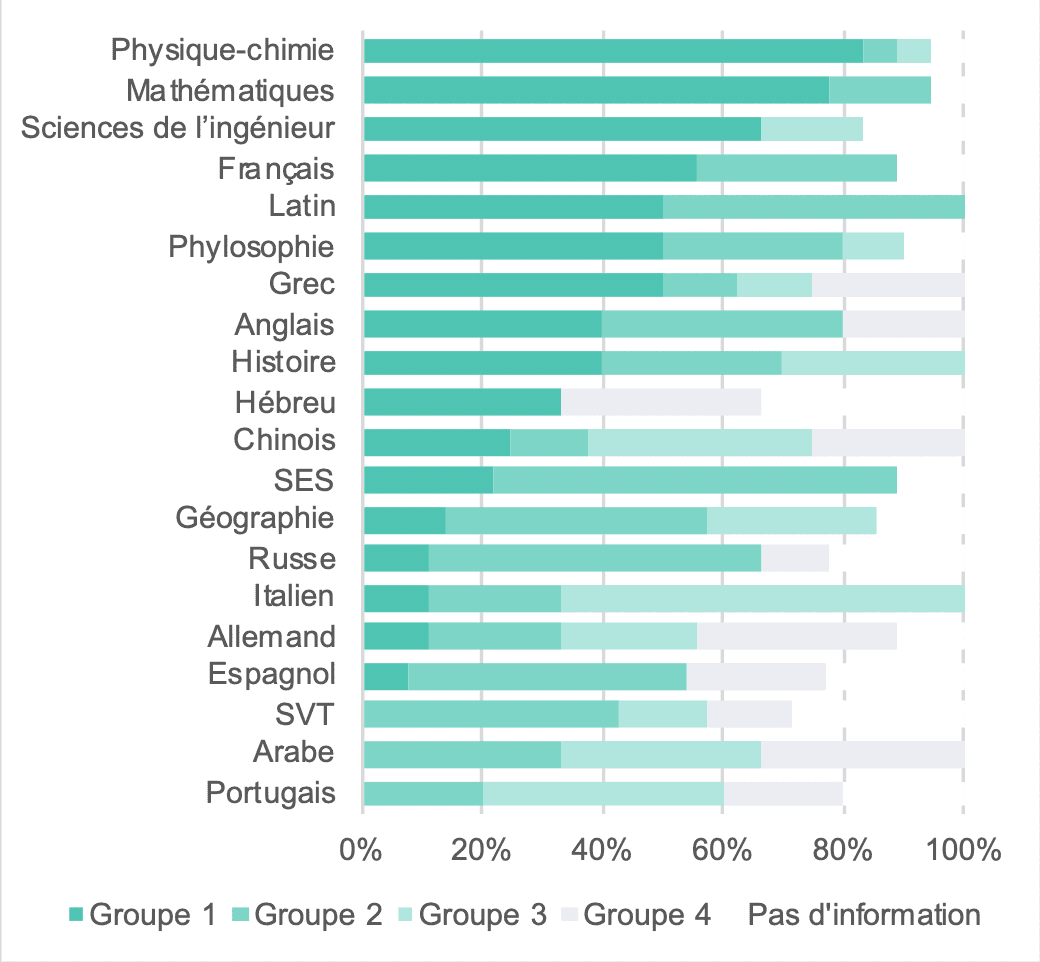
Répartition des élèves selon les matières en fonction des différents groupes d’écoles
The number of prizes awarded is correlated with the selectivity of the schools former winners went on to, except for 4 languages (Arabic, German, Italian and Spanish).
Since 2015, 139 winners have received awards in mathematics and 116 in Latin, against an average of 54 winners per test over five years.
The "pillar" subjects, mathematics, physics and chemistry, French and Latin, point their winners toward high-level academic careers. Along with Greek, they are four of the five historical subjects of the Concours Général.
2. The big Paris lycées put particular effort into the most prestigious subjects. 50% of the awards in these subjects go to students from the 4 leading lycées identified above, and nearly 20% to Louis-le-Grand alone. The less prestigious third of subjects is much more spread out: it takes 17 lycées to reach 50% of the prizes, and the 4 big Paris lycées are not among the best in these subjects.
These figures come from (i) the concentration of the best students in the most prestigious lycées, which can select their students, and (ii) the specific preparation needed to win an award in the Concours Général.
The big lycées assign teachers to students preparing for the Concours Général.
International lycées excel at preparing students for the language tests and are versatile, unlike French lycées abroad.
1. French lycées abroad win many of the language awards (relative to their number of students), but international lycées in France get excellent results in these subjects too. The Lycée international de Saint-Germain-en-Laye and the Franco-German lycée in Buc outperform the big Paris lycées and rank first and second in languages. The Lycée international des Pontonniers and the Centre international de Valbonne come fourth, behind Henri IV, and sixth, behind Louis-le-Grand.
In five years, students from international lycées won 92 honorable mentions, accessits and prizes in languages.
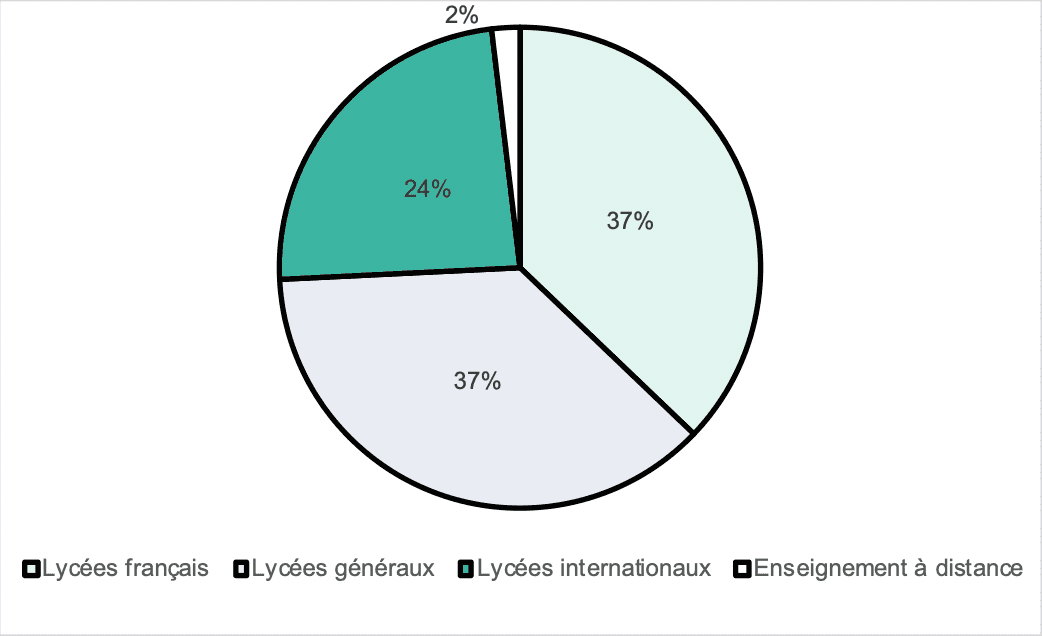
Un taux important de points dans les lycées internationaux en France pourtant largement minoritaires en nombre face aux lycées d’enseignement général
2. International lycées are also very versatile in language teaching. Every international lycée with more than one award in a language test of the Concours Général won its prizes in different languages.
The Lycée international de Saint-Germain-en-Laye has winners in seven different languages. The Lycée international des Pontonniers in Strasbourg comes second for variety, with winners in five different languages.
French lycées abroad, by contrast, win many language awards but in very few languages: only 3 lycées had winners in a language other than the national language of their country.
98% of the language awards won by French lycées abroad were in the national language of their country.
3. The type of lycée that wins also differs from one language to another. The European languages most often chosen at the baccalauréat apart from English (German, Portuguese, Italian and Spanish) share the same profile, with winners spread evenly across international lycées, French lycées in those countries and other lycées. English follows the same pattern, with international lycées ahead.
The four non-European languages, which along with Turkish are the only languages not spoken in the European Union to have more than a thousand candidates, have very uneven profiles, unlike the other languages:
Chinese is spread much like the European languages, with international lycées less dominant;
none of the Russian winners of the last five years came from a French lycée in Russia, even though Russia has French lycées that prepare students for the various tests and a few winners among their candidates;
more than 80% of the Hebrew winners come from Jewish lycées in Paris;
in Arabic, unlike Hebrew, almost all the winners attend French lycées in Arab countries.
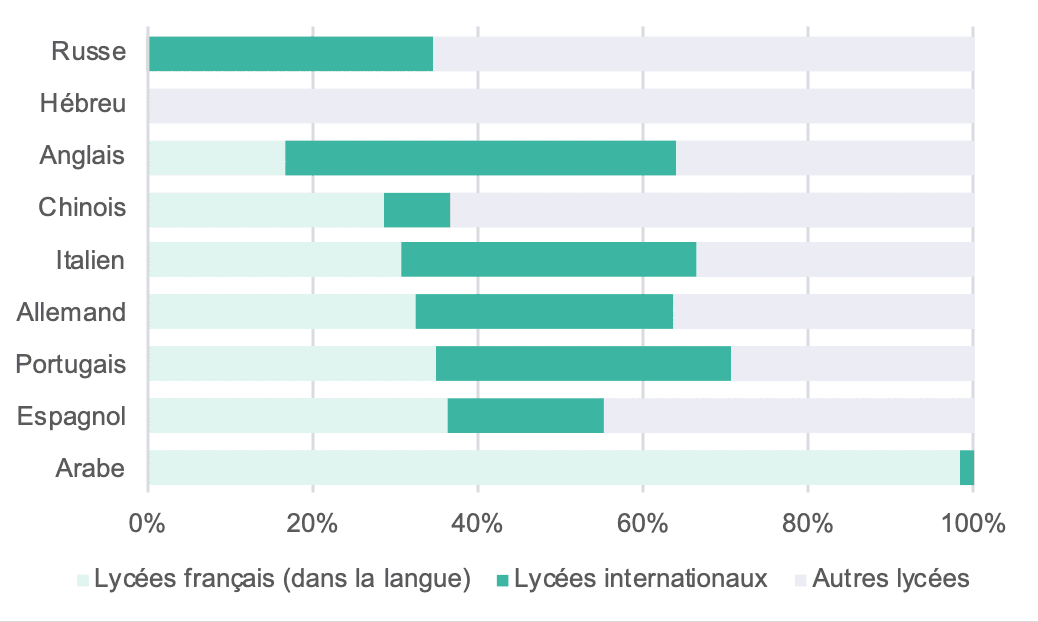
La part des différents types de lycée est très variable en fonction de la langue