The INSP aims to diversify the senior civil service by recruiting from a wider range of social and professional backgrounds.
All the candidates admitted in the 2021 session held a master's degree (or equivalent), but the INSP is open to anyone with a bachelor's degree who is a national of a European Economic Area member state (including the European Union). Admission is by competitive exam, through five routes:
The external exam: 40 places for students
The external "talents" exam: a scheme that guarantees 5 extra places for students who meet social criteria
The external "doctors" exam: 4 places for PhD holders, whose subject rotates every year over a three-year cycle between "Physical sciences and engineering", "Humanities and social sciences" and "Life sciences"
The internal exam: 32 places for public servants (with at least four years of experience)
The third exam: 7 places for private-sector professionals (with at least eight years of experience)
The exams have two stages: eligibility (written) and admission (oral). The process depends on the route. The "doctors" exam has only one written test, an analysis and recommendations note based on a file of up to 25 pages, and two oral tests: a personal interview that, unlike the other routes, includes a substantial technical part on the year's subject, and the English oral (common to all routes). The external exam (standard and "talents") follows the same process, with five written tests: three essays, on public law, on economics and on a general contemporary question about the role of public authorities and their relationship with society, plus two notes: an analysis and recommendations note on social issues based on a file (up to 25 pages), and one on public finance. The internal and third exams use the same written tests, except that the essays on public law and economics are replaced by analysis notes on document files covering the same subjects. The oral tests are the same for the four exams (external, "talents", internal and third): three oral tests on European Union affairs, international affairs and English, a personal interview and a group interaction exercise.
A full set of state-accredited preparation courses trains candidates for the different exams.
Preparatory classes for the external exam (standard and "talents") are run by the IEPs (Sciences Po, Sciences Po Aix, Sciences Po Bordeaux, Sciences Po Grenoble, Sciences Po Lille, Sciences Po Rennes, Sciences Po Strasbourg, Sciences Po Toulouse) and by two universities: Université Paris I Panthéon-Sorbonne and Université Paris-Dauphine - PSL.
The prép'ENA courses of the two universities award a Master 2:
the professional master "Affaires publiques – concours de la haute fonction publique" of the civil service preparation center (CIPCEA) of Université Paris I Panthéon-Sorbonne and the École normale supérieure
the professional master "Carrières publiques et grands concours" of Université Paris-Dauphine – PSL
"Talents du service public" preparatory classes also prepare for the external "talents" exam. Admission is on application, includes selection on social criteria and leads to one of three classes:
Strasbourg (24 places): run by the INSP with the Institut national des études territoriales and Sciences Po Strasbourg
Paris (24 places): run by the INSP
Nantes (24 places): run by the INSP with the Institut national des études territoriales and the Université de Nantes
Preparation for the internal exam also goes through accredited preparatory classes, mainly at the IEPs (Sciences Po, Sciences Po Aix, Sciences Po Bordeaux, Sciences Po Grenoble, Sciences Po Lille, Sciences Po Rennes, Sciences Po Strasbourg, Sciences Po Toulouse) but also at the Institut de la gestion publique et du développement économique (IGPDE).
For the third exam, the INSP assigns candidates to one of five preparatory classes, at Sciences Po Bordeaux, Sciences Po Grenoble, Sciences Po Rennes, Sciences Po Strasbourg or the Institut de la gestion publique et du développement économique (IGPDE).
Sciences Po Lyon and Sciences Po Saint-Germain-en-Laye do not offer an INSP preparatory class.
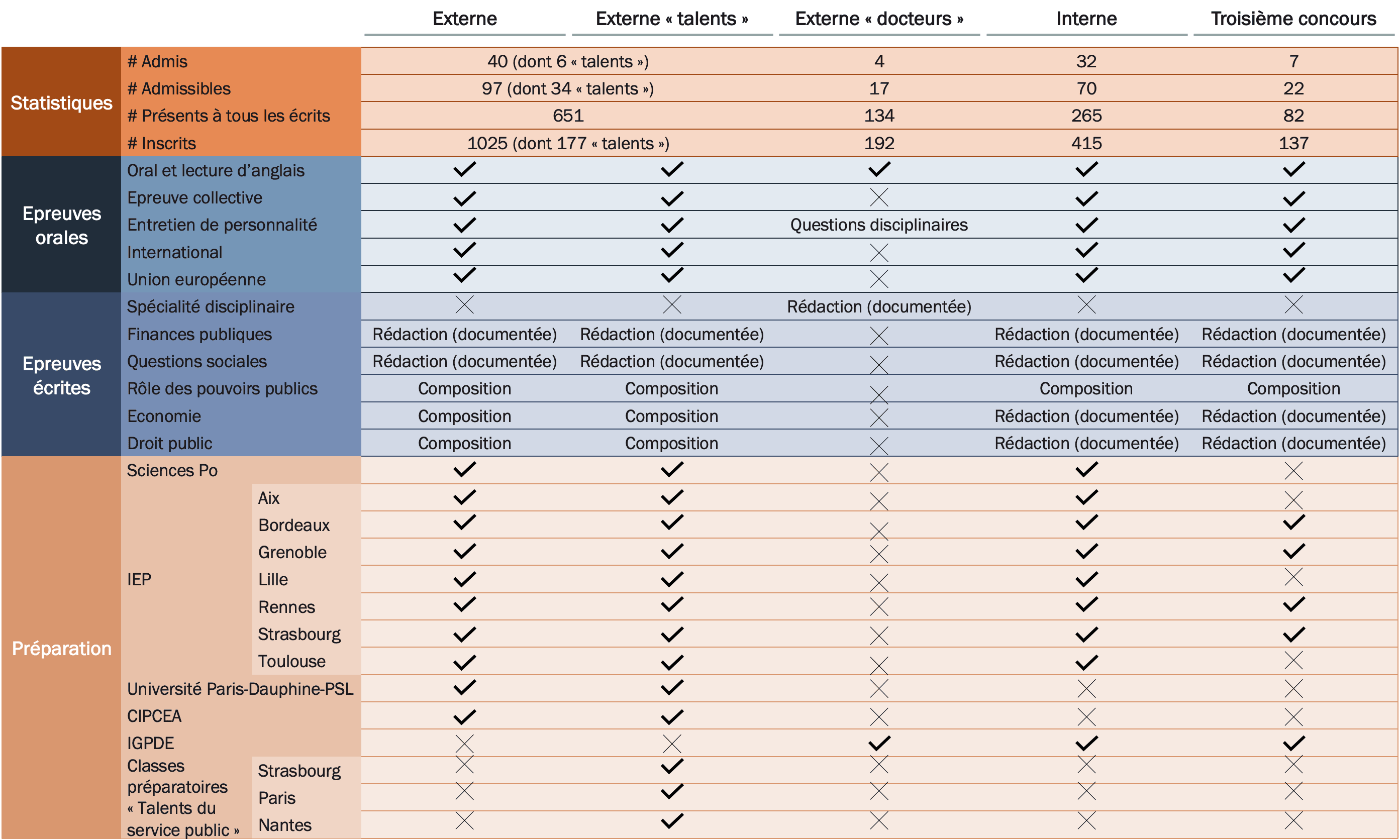
Dispositif de recrutement de l'INSP
Most admitted students are still former IEP students, especially from Sciences Po.
To best describe the profile of future INSP students, the reference degree is the first master's program the student started (and completed).
By graduation year, students admitted through the external exam are spread over the three previous years, about a third per year, and only two candidates were admitted during the final year of their master's. Preparing for the external exam would therefore take a year and a half on average and would be very hard to combine with another program.
For the three other exams, graduation years are spread fairly evenly over the ten years between 5 and 15 years before the exam.
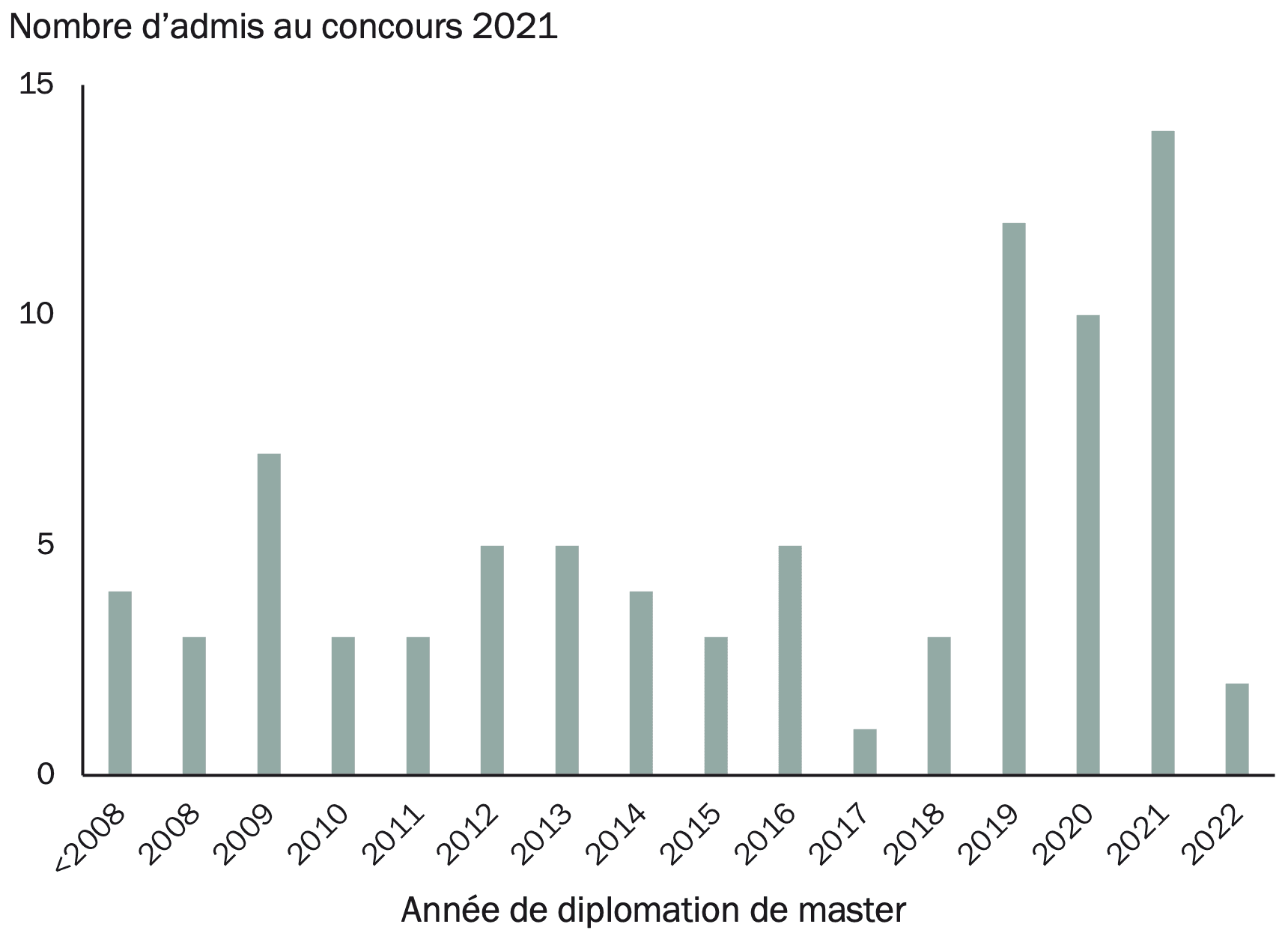
Année de première diplomation de master
The overhaul of the tests (especially the orals) and the growing number of exams have widened the range of backgrounds, but Sciences Po remains the main route.
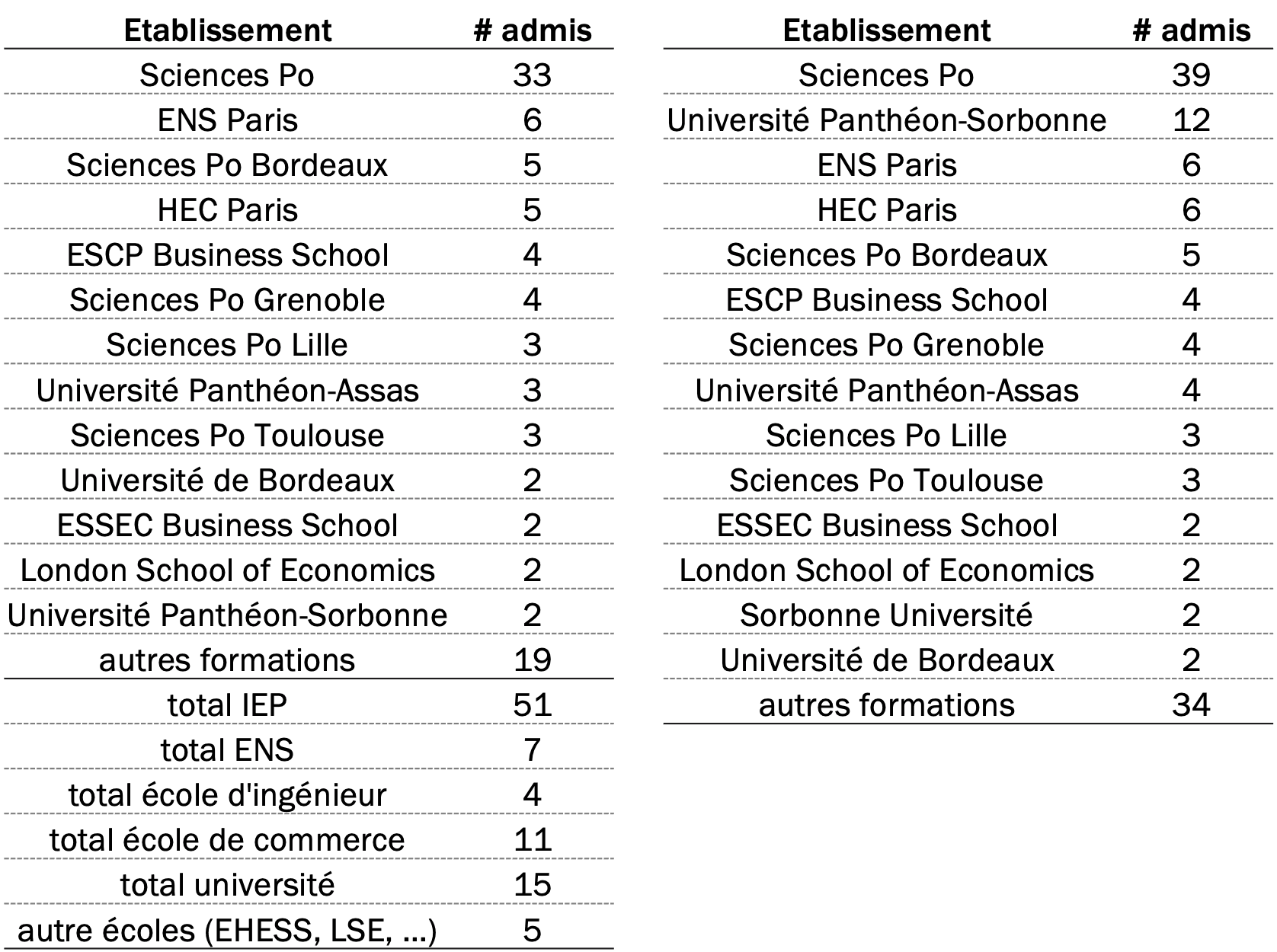
Répartition des formations : à gauche le nombre primo diplômés de master ; à droite le nombre total de diplômés de master. Exemple : master à Sciences Po (comptabilisé à gauche et à doite) avant un master à l'Université Panthéon-Sorbonne (comptabilisé seulement à droite)