The Ministry of the Armed Forces oversees several grandes écoles and runs a complete training system for its future officers. There are two main kinds of training: one for officers of the four main branches (Air and Space Force, Army, Navy and Gendarmerie) and one for officers of the technical corps. Within each category, admission procedures vary widely and the degrees awarded differ.
1. Training officers for the four branches:
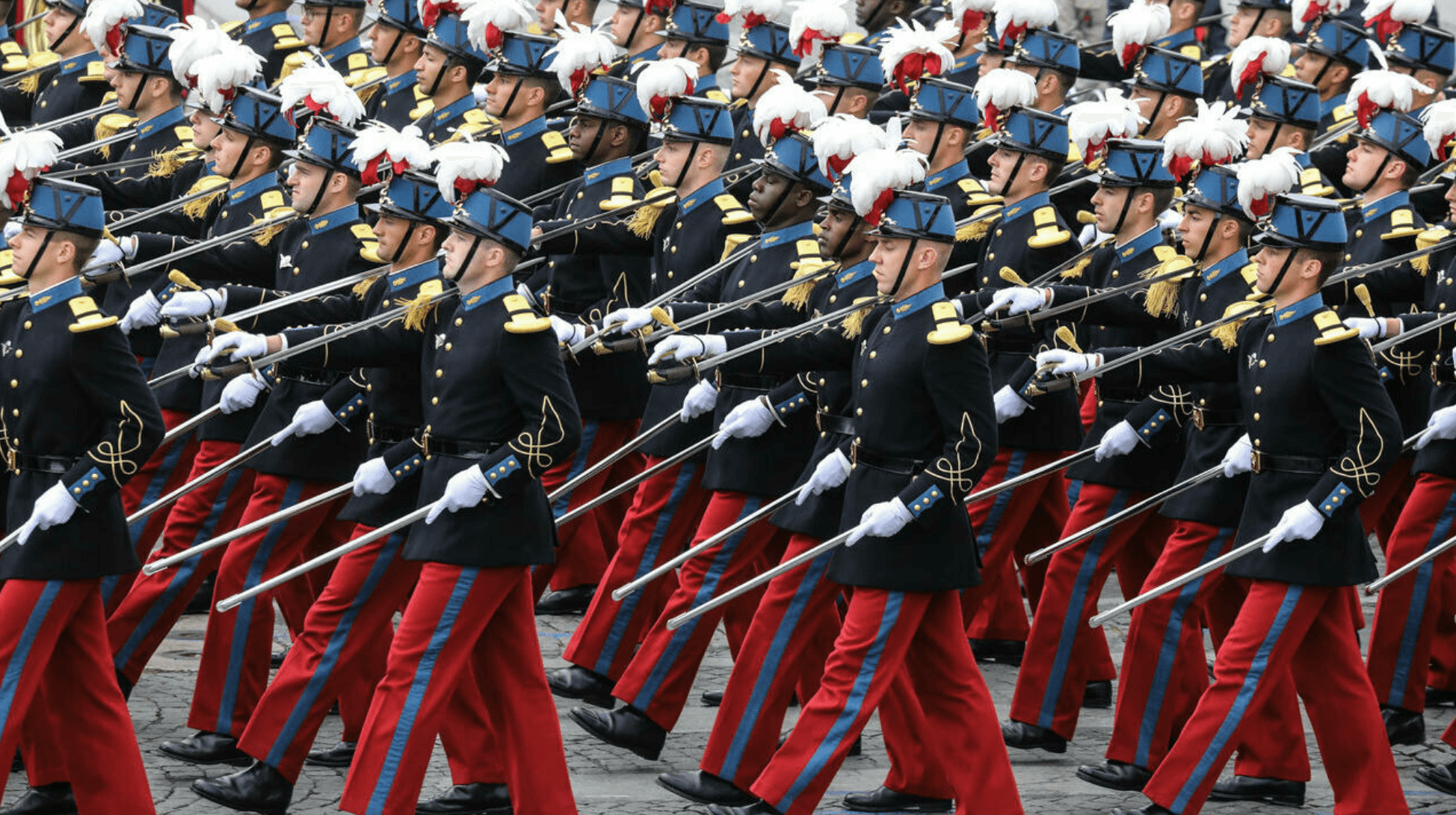
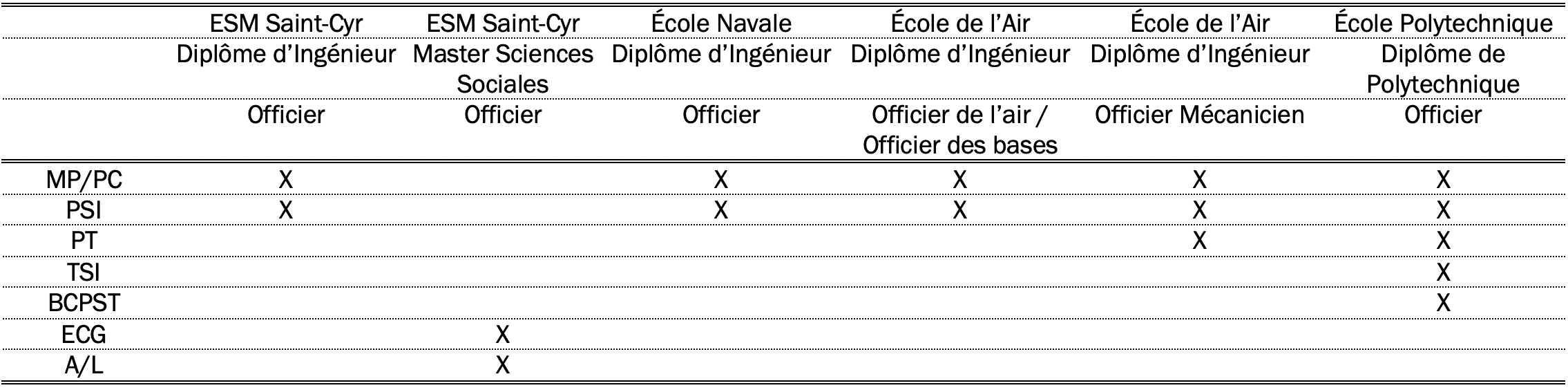
Five schools provide the initial training of officers: the École spéciale militaire de Saint-Cyr (Army), the École navale (Navy), the École de l'air (Air and Space Force), the École des officiers de la Gendarmerie nationale (Gendarmerie) and École polytechnique (which leads to every branch).
Apart from the École des officiers de la Gendarmerie nationale, the four other schools award a master's-level degree and recruit after two or three years of higher education. Admission routes, training and skills differ between the schools, but all four recruit most of their officer cadets from preparatory classes for the grandes écoles (mainly in the sciences).
The École des officiers de la Gendarmerie nationale selects its students on application after a Master 2 (mostly graduates of the four other officer schools), for a two-year program.
2. Training officers for the technical corps:
National defense also relies on technical corps, mostly reached through engineering programs at various schools (mainly under the Ministry of the Armed Forces: ENSTA Bretagne, École polytechnique, etc.).
The technical corps and how to join them:
The Corps de l'Armement: the most prestigious technical corps and the only one that can lead to the rank of five-star general officer. It is overseen by the Direction générale de l'armement (DGA). Holders of an engineering degree or an École normale supérieure degree can join through an exam, but the corps recruits mostly by class rank at the end of École polytechnique (whatever the initial admission route). Its engineers are meant to become senior leaders of the DGA and of the defense sector (heads of the DGA schools: Polytechnique, ENSTA Paris, ENSTA Bretagne or ISAE-Supaéro, the armaments directorate, the executive management of Thales, etc.). Training takes place mainly at ENSTA Paris and ISAE-Supaéro and can lead to the engineering degree of either school.
The Corps des ingénieurs des études et techniques de l'armement (IETA): IETA engineers work on weapons programs and operations, and on preparing, building and supporting defense systems. Students join this corps while earning an engineering degree, through the ENSTA Bretagne exam (Mines-Télécom) in MP, PC, PSI and PT; 43 places were filled in the 2021 session. Later in their careers, IETA engineers can apply to the Corps de l'Armement through an internal exam. Students who want to specialize in aeronautics and space spend their final year at ISAE-Supaéro.
The Corps des ingénieurs militaires de l'infrastructure (IMI): this corps belongs to the Service d'infrastructure de la défense (SID). Its officer engineers run the construction, renovation and maintenance projects of the ministry's buildings and technical facilities. As with the IETA, students join the IMI while earning an engineering degree. The corps recruits through the Arts et Métiers exam in PSI and PT (12 places filled in the 2021 session) and through an internal exam after the first year at Arts et Métiers. The program lasts four years: one year at an officer school, then the three years of the engineering program at the Angers campus.