Which engineering schools are the most attractive to prépa students?
Every year, tens of thousands of prépa students make a decisive choice: among the schools that admitted them, which one will they finally say "yes" to? That choice, often boiled down to a withdrawal or an acceptance, reveals something valuable: students' real preferences, school by school.
At DAUR, we wanted to answer a simple question: which schools are the most attractive to students in the science CPGE tracks? To do so, we carried out a first-of-its-kind analysis, inspired by what SIGEM publishes every year for business schools, but extended to all the science tracks and all exam boards, and covering nearly 400 programs.
A rigorous, first-of-its-kind methodology
We rebuilt the cross-withdrawals for the main CPGE tracks: MP, MPI, PC, PSI, PT, TSI, BCPST, TB, TPC, ATS Génie Industriel and ATS Génie Civil. In total, 1,649,004 withdrawals were modeled, for 446 possible choices at 185 schools, covering the whole range: engineering schools, veterinary schools, ENS, military schools, etc.
This database was made possible by:
Direct collaboration with many schools and exam boards;
Methodically rebuilding the matrices from public data: admission lists, ranks and enrollment statistics.
The analysis relies on a log-linear model. This model, well known in experimental economics and choice theory, computes relative attractiveness scores from the preferences revealed between pairs of schools. What matters here is not a school's raw selectivity (the subject of a future article), but the fact that a student who can choose between two schools picks one over the other.
Understanding the attractiveness score
Each school gets an attractiveness score from which, for any pair of schools, we can compute the probability that a student prefers one to the other.
The score follows a log-linear scale:
If two schools have the same score, each has a 50% chance of being chosen over the other;
A school 1 point ahead is chosen about 73% of the time;
A 2-point gap gives an 88% probability;
Scores are transitive: if A is 1.2 above B and B is 1.2 above C, then A is 2.4 above C.
The system therefore does more than rank schools: it compares their attractiveness on a consistent, continuous scale.
Dealing with bias: a realistic view of the exams
The analysis had to deal with several structural biases, which DAUR handled carefully:
1. Exam registration bias
Not every student sits every exam. A student at Polytechnique's level, for example, does not necessarily register for the CCINP. To account for this, we modeled, for each exam, the probability of registering according to the student's level.
Example: of the 59 PSI students admitted to Polytechnique, only 6 were ranked in the CCINP, so 10% registered for that exam at equal level. This ratio is used to weight the withdrawals.
2. Bias from schools present in several tracks
Schools do not appear in every track. ESPCI, for example, is only open to PC and BCPST students, while CentraleSupélec is present everywhere. Being present in several tracks exposes a school to more potential withdrawals.
DAUR therefore ran the study track by track, then adjusted the scores to account for relative attractiveness across tracks.
3. Exam board and selectivity effects
Some schools recruit through a shared exam board (e.g. CCINP), others have their own ranking (e.g. ENSTIB). Schools in a shared board get withdrawals from students who were never really interested in them.
Example: a student drawn to computer science may turn down ENSTIB through the CCINP but would never have applied to it directly. DAUR therefore modeled a withdrawal adjustment based on the structure of each exam.
Results
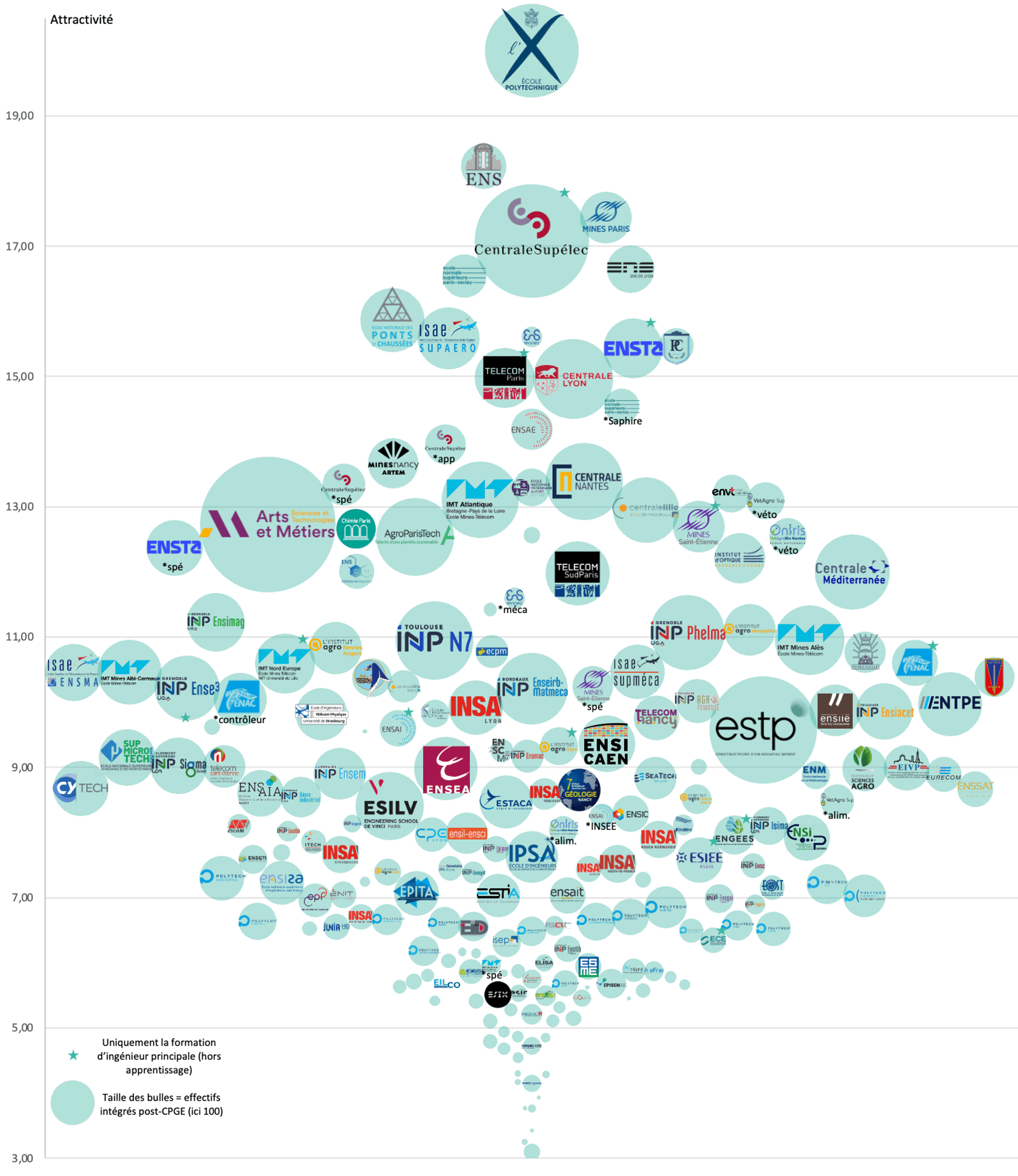
Illustration complète de l'attractivité des écoles scientifiques post-CPGE 2026 (session 2025) -i.e. écoles d'ingénieurs, écoles normales, écoles militaires, écoles vétérinaires, etc.- les écoles de moins de 15 intégrées n'ont pas leur logo sur le graphique.
Key messages
The analysis brings out several key lessons on how prépa students choose:
Prestige dominates preferences at the top of the ranking
The so-called top schools, whether general (Polytechnique, Mines Paris, CentraleSupélec, etc.) or highly specialized (ESPCI, ENS, ISAE, etc.), stand out with clear attractiveness gaps.
The prestige of the school remains a major factor for the best-ranked students, which reinforces the implicit hierarchy of the French grandes écoles.
Across the first 13 schools (including 4 ENS), the attractiveness score varies by more than 5 points for only 2,709 admitted students. In other words, the hierarchy is very sharp for a small share of students.
Beyond the top 10, field and employability guide the choice
Covering the same range again (5 more points) takes 47 schools this time (nearly 4 times as many) and 7,431 admitted students.
Beyond the top of the ranking, choices become less polarized and depend more on factors such as:
Fit with career plans (computer science, energy, biology…);
The school's field of specialization;
Employability in a target sector.
In the middle of the table, many criteria come into play
From the middle of the ranking down, attractiveness depends less on reputation or selectivity and more on a set of qualitative factors:
Location (being in the regions, close to family);
Teaching format (projects, work-study, internships…);
Cost of studies, public or private status;
International opportunities;
Student life and surroundings.
The choice becomes much more personal, as admission paths grow more individual. The result is 131 schools spread over 5 more points of attractiveness, with 7,367 admitted students (excluding the tail of the distribution)
Three dividing lines and 4 groups of schools
Student assignment shows groups of schools with distinct behaviors, which appear as clusters.
The elite schools (x>14.9): 9 engineering schools at the top of recruitment in every track (École polytechnique, Mines Paris-PSL, CentraleSupélec, École nationale des Ponts et Chaussées, ISAE-Supaéro, ENSTA, ESPCI Paris-PSL, Télécom Paris, Centrale Lyon) and the 4 ENS (ENS-PSL, ENS Lyon, ENS Paris-Saclay, ENS Rennes)
The rest of tier 1 (14.9<x<12): the regional Mines and Centrales (Mines Nancy and Saint-Étienne, IMT Atlantique, Centrale Nantes, Lille and Méditerranée), the best specialized schools (AgroParisTech, Chimie ParisTech-PSL, Chimie Montpellier, IOGS, Télécom SudParis, the 4 national veterinary schools), the specialized and apprenticeship programs of the elite schools (ENSTA, CentraleSupélec, Télécom Paris, ENS Paris-Saclay-SAPHIRE, ENS Rennes-Mécatronique) and Arts et Métiers
Tier 2 (12<x<8.3): the core of the big exams (notably CCINP, Mines-Télécom and Agro BCPST) with the main recruiters of each track: Grenoble INP, Bordeaux INP, Toulouse INP, ESTP, Institut Agro, IMT (Alès, Albi, Nord Europe), etc., as well as the big recruiters of the Avenir exam (at the bottom of tier 2), ESTACA and ESILV
Tier 3 (<8.3): all the other schools. Intakes in this group are much smaller, partly because some programs do not fill their places: a tier 3 school recruits 33 CPGE students on average, against 126 for tier 2.
Data reliability: unmatched coverage
Our analysis rests on exceptionally good data:
Exact data for 75% of admitted students
X-ENS-ESCPI (MP, MP-Info, MPI, PC, PSI, PT, TSI, BCPST, TB, TPC) : Ecole Polytechnique, ENS Ulm-PSL, ENS de Lyon, ENS Paris-Saclay, ENS Rennes), CNES : ENS Ulm-PSL, Mines-Ponts common exam (MP, MPI, PC, PSI, PT, TSI) : (Mines Paris-PSL, Ecole Nationale des Ponts et Chaussées, ENSTA, ISAE-Supaéro, Télécom Paris, ENSAE Paris, Chimie ParisTech-PSL, ENSTA Paris (apprentissage), Télécom Paris (apprentissage), Mines Nancy, IMT Mines Saint-Etienne, IMT Atlantique), Mines-Télécom common exam (MP, MPI, PC, PSI, PT, TSI) : (ENSG, ENSG-Géomatique, ENSG-Géomatique (fonctionnaire), ENSIIE, ENSSAT, ENSTA Bretagne, ENSTA Bretagne (IETA), Ecole Météorologie, Ecole Météorologie (fonctionnaire)EIVP, EIVP (fonctionnaire), ENTPE, ENTPE (fonctionnaire), EURECOM, IMT Mines Albi, IMT Mines Alès, IMT Nord Europe, IMT Nord Europe (fonctionnaire), IMT Mines Saint-Etienne (ISMIN), Télécom Nancy, TPS Informatique et Réseaux, TPS TI-Santé, Télécom Saint-Etienne, Télécom SudParis, IMT Business School), INP common exam (MP, MPI, PC-CH, PC-PH, PSI, PT, TSI, TPC) : (Bordeaux INP - ENSC Cognitique, Bordeaux INP – ENSEGID, Bordeaux INP - ENSEIRB-MATMECA Electronique, Bordeaux INP - ENSEIRB-MATMECA Informatique, Bordeaux INP - ENSEIRB-MATMECA Mathématiques et Mécanique, Bordeaux INP - ENSEIRB-MATMECA Télecom, Bordeaux INP - ENSMAC Chimie-Génie physique, Bordeaux INP – ENSPIMA, Bordeaux Sciences Agro, Chimie ParisTech, Clermont Auvergne INP - SIGMA – chimie, Clermont Auverge INP - SIGMA Clermont – Mécanique Avancée, Clermont Auvergne INP – ISIMA, CPE ETI : Electronique , Télécommunications, Informatique, CPE LYON Chimie – génie des procédés, CPE Lyon - apprentissage - Physique et Systèmes Microélectronique, CY TECH Cergy – Biotechnololgie, CY TECH Cergy - Génie Civil, CY TECH Cergy-Pau – Informatique, CY TECH Cergy-Pau – Mathématiques, ECPM - ESBS Strasbourg – CHEMBIOTECH, ECPM, EIL Côte d'Opale - Boulogne (Agroalimentaire), EIL Côte d'Opale - Dunkerque (Génie Energétique et Environnement), ENAC Toulouse Civil, ENAC Toulouse Fonctionnaire, ENGEES Strasbourg Civil (apprenti), ENGEES Strasbourg Civil (étudiant), ENGEES Strasbourg Fonctionnaire, ENSAI Rennes Civil, ENSAI Rennes Fonctionnaire (Attaché INSEE), ENSAIA, ENSC Lille, ENSC Montpellier, ENSC Mulhouse, ENSC Rennes, ENSGTI Pau – Energétique, ENSGTI Pau - Génie des Procédés, ENSGTI Pau - Génie éléctrique et informatique industrielle FISA, ENSI Poitiers - Génie de l'Eau et Génie Civil, ENSI Poitiers Energétique et Environnement, ENSICAEN Génie Physique et systèmes Embarqués, ENSICAEN Informatique, ENSICAEN Mat. Et Chimie, ENSIL - ENSCI Limoges Céramique Industrielle, ENSIL - ENSCI Limoges Génie civil, ENSIL - ENSCI Limoges Photonique, ENSIL - ENSCI Limoges Génie de l'Eau et Environnement, ENSIL - ENSCI Limoges Electronique et Télécommunications, ENSIL - ENSCI Limoges Matériaux, ENSIL - ENSCI Limoges Mécatronique, ESCOM Chimie Compiègne, Grenoble INP - ENSE3, Grenoble INP – ENSIMAG, Grenoble INP - Esisar, Grenoble INP – Pagora, Grenoble INP - Phelma (Physique Electronique Télécoms), Grenoble INP - Phelma (Physique Matériaux Procédés), ISAE-ENSMA Poitiers, ISAE-Supméca Paris, ITECH Lyon, L'Institut Agro - Dijon (cursus ingénieur, en alimentation durable), Lorraine INP - ENSEM – Energie, Lorraine INP - ENSEM - Spécialité des systèmes numériques, Lorraine INP – ENSIC, Lorraine INP - ENSIC – Alternance, Oniris VetAgroBio Nantes (cursus alimentation), SeaTech Toulon, SUPMICROTECH ENSMM Besançon, TELECOM PHYSIQUE Strasbourg, Toulouse INP - ENSEEIHT - Electronique-Energie-Automatique (EEA), Toulouse INP - ENSEEIHT - Mécanique des Fluides-Energetique-Environnement (MFEE), Toulouse INP - ENSEEIHT - Sciences du Numérique, Toulouse INP - ENSIACET - Chimie, Toulouse INP - ENSIACET - Génie chimique, Toulouse INP - ENSIACET - Génie des Procédés, Toulouse INP - ENSIACET - Génie Industriel, Toulouse INP - ENSIACET – Matériaux), Polytech network (MP, MPI, PC, PSI, PT, TSI, BCPST, TB) : ECPM - ESBS Strasbourg – CHEMBIOTECH, ENSIBS Cybersécurité du logiciel, ENSIBS Génie Industriel, ENSIBS Mécatronique, ENSIM Le Mans, ENSTBB Bordeaux, EPISEN - Génie Biomédical et santé (ISBS), EPISEN - Système d'information, EPISEN - Technologie pour la santé, ESBS Strasbourg, ESGT le Mans, ESI Reims – Energetique, ESI Reims - Génie Urbain et Environnement, ESI Reims – Packaging, ESIAB - Microbiologie et Qualité / Production, Innovation , Biotechnologies en agro-alimentaire, ESIR Rennes – Informatique, ESIR Rennes - Matériaux , ESIR Rennes - Technologies de l'information pour la santé, ESIROI La Réunion, ESIX Caen Agroalimentaire, ESIX Caen Mécatronique et Systèmes Embarqués, ESIX Cherbourg - Génie Industriel, ESIX Cherbourg - Génie nucléaire, ISAT Nevers - département ESA (Energétique et systèmes autonomes), ISAT Nevers - département MIT (Mécanique et Ingénierie des Transports), ISAT Nevers - Infrastructures et Réseaux de Transports, ISEL Le Havre, ISIFC Besançon - Génie Biomédical, ISTY Vélizy, Polytech Angers - Bâtiment : Exploitation, Maintenance et Sécurité, Polytech Angers - Génie Biologique et Santé, Polytech Angers - Qualité Innovation Fiabilité, Polytech Angers - Systèmes Automatisés et Génie Informatique, Polytech Annecy-Chambéry - Bâtiment Eco-construction Energie, Polytech Annecy-Chambéry - Ecologie industrielle et territoriale, Polytech Annecy-Chambéry - Informatique données Usages, Polytech Annecy-Chambéry - Mécanique Mécatronique Matériaux composites, Polytech Annecy-Chambéry - Systèmes Numériques – Instrumentation, Polytech Clermont - Génie Biologique, Polytech Clermont - Génie Civil, Polytech Clermont - Génie Electrique, Polytech Clermont - Génie Physique, Polytech Clermont - Ingénierie Mathématique et Data Science, Polytech Dijon - Electronique et systèmes numériques, Polytech Dijon - Informatique et réseaux, Polytech Dijon – Matériaux, Polytech Dijon – Robotique, Polytech Grenoble - Géotechnique et génie civil, Polytech Grenoble - Gestion des Risques, Polytech Grenoble – Informatique, Polytech Grenoble - Informatique et électronique des systèmes embarqués, Polytech Grenoble – Matériaux, Polytech Grenoble - Technologies de l'information pour la santé, Polytech Lille - Génie biologique et alimentaire, Polytech Lille - Génie civil, Polytech Lille - Informatique et statistique, Polytech Lille - Instrumentation et ingénierie d'affaires , Polytech Lille – Matériaux, Polytech Lille – Mécanique, Polytech Lille - Systèmes embarqués, Polytech Lyon - Génie Biomédical, Polytech Lyon – Informatique, Polytech Lyon – Matériaux, Polytech Lyon - Mathématiques Appliquées et Modélisation, Polytech Lyon – Mécanique, Polytech Lyon - Systèmes industriels, Robotique, Polytech Marseille - Génie Biologique, Biotechnologie, Polytech Marseille - Génie Biomédical, Polytech Marseille - Génie Civil, Polytech Marseille - Génie Industriel et Informatique, Polytech Marseille – Informatique, Polytech Marseille – Matériaux, Polytech Marseille - Mécanique, Energétique, Polytech Marseille - Microélectronique, Télécommunications, Polytech Montpellier - Génie biologique et agroalimentaire, Polytech Montpellier - Informatique et Gestion, Polytech Montpellier – Matériaux, Polytech Montpellier - Mécanique et Interactions, Polytech Montpellier - Microélectronique et Automatique, Polytech Montpellier - Sciences et technologies de l'eau, Polytech Nancy - Energie, Mécanique, Matériaux, Environnement , Polytech Nancy - Informatique, Automatique, Robotique, Réseaux, Polytech Nancy - Management opérationnel, Maintenance, Maîtrise des risques, Polytech Nantes - Électronique et technologies numériques, Polytech Nantes - Énergie électrique, Polytech Nantes - Génie civil, Polytech Nantes - Génie des Procédés et Bioprocédés, Polytech Nantes – Informatique, Polytech Nantes – Matériaux, Polytech Nantes - Thermique, Énergétique, Mécanique, Polytech Nice-Sophia – Bâtiments, Polytech Nice-Sophia - Électronique et Systèmes Embarqués, Polytech Nice-Sophia - Génie biologique, Polytech Nice-Sophia - Génie de l'eau, Polytech Nice-Sophia – Informatique, Polytech Nice-Sophia - Mathématiques appliquées, Modélisation, Polytech Nice-Sophia - Robotique – Systèmes Autonomes, Polytech Orléans - Génie civil et géo-environnement, Polytech Orléans - Génie industriel, Polytech Orléans - Génie physique et systèmes embarqués, Polytech Orléans - Innovation en Conception et Matériaux, Polytech Orléans - Technologies pour l'Énergie, l'Aérospatial et la Motorisation, Polytech Paris-Saclay - Electronique et Informatique pour l'Embarqué, Polytech Paris-Saclay - Informatique et ingénierie mathématique, Polytech Paris-Saclay – Matériaux, Polytech Paris-Saclay - Photonique et systèmes optroniques, Polytech Sorbonne – Agroalimentaire, Polytech Sorbonne - Electronique et Informatique, Polytech Sorbonne – Matériaux, Polytech Sorbonne - Mathématiques Appliquées et Informatique, Polytech Sorbonne – Robotique, Polytech Sorbonne - Sciences de la Terre : Aménagement, Risques, géo-Energies, Polytech Tours - Électronique et génie électrique , Polytech Tours - Génie de l'aménagement et de l'environnement, Polytech Tours – Informatique, Polytech Tours - Mécanique, Conception de systèmes, Sup'Biotech (école privée), Sup Galilée Villetaneuse), EPITA (MP, MPI, PC, PSI, PT, TSI) : EPITA, IPSA, ESME, Agro common exam (BCPST, TB) : AgroParisTech, ENSP Versaille, Bordeaux Sciences Agro, CentraleSupélec, ENGEES Strasbourg Civil (étudiant), ENSAT, ENSAIA, L'Institut Agro - Dijon (cursus ingénieur, spécialités agronomie civil), L'Institut Agro - Dijon (cursus ingénieur, en alimentation durable), L'Institut Agro - Dijon (cursus ingénieur, spécialités agronomie fonctionnaire), L'Institut Agro - Montpellier (cursus ingénieur, spécialité agronomie), L'Institut Agro - Montpellier (cursus ingénieur, spécialité agronomie et agroalimentaire (SAADS)), L'Institut Agro Rennes - Angers (cursus ingénieur, spécialités agronomie), L'Institut Agro Rennes - Angers (cursus ingénieur, spécialités Horticulture et Paysage), Oniris VetAgroBio Nantes (cursus alimentation), VetAgro Sup, PC Agro (BCPST) : ESPCI Paris-PSL, Chimie ParisTech, Bordeaux INP - ENSMAC (ex ENSCBP) Agroalimentaire-Génie biologique, Bordeaux INP - ENSMAC (ex ENSCBP) Chimie-Génie physique, ENSC Lille , ENSC Montpellier, Lorraine INP - ENSIC, G2E (BCPST) : Bordeaux INP – ENSEGID, ECOLE METEOROLOGIE (fonctionnaire), EIL Côte d'Opale - Dunkerque (Génie Energétique et Environnement), ENGEES Strasbourg Civil (apprenti), ENGEES Strasbourg Civil (étudiant), ENGEES Strasbourg Fonctionnaire, ENSG Nancy, ENSG-Géomatique Marne la Vallée, ENSG-Géomatique Marne la Vallée Fonctionnaire, ENSI Poitiers - Génie de l'Eau et Génie Civil, ENSI Poitiers Energétique et Environnement, ENSIL - ENSCI Limoges Céramique Industrielle, ENSIL - ENSCI Limoges Génie de l'Eau et Environnement, ENTPE Lyon Civil, ENTPE Lyon Fonctionnaire, EOST Strasbourg, ESGT le Mans, IMT Mines Albi, IMT Mines Alès, IMT Nord Europe, INSA Group, biotechnology and health (MP, MPI, PC, PSI, PT, BCPST, TB, TPC) : INSA Lyon Biotechnologies et Bioinformatique, INSA Toulouse Génie Biologique, ESITech Rouen - Physique pour la Santé, ESITech Rouen - Technologies du Vivant, ENSEA ATS Génie Industriel exam : Centrale Lille, Centrale Nantes, CentraleSupélec - cursus apprenti - Campus Metz, CentraleSupélec - cursus apprenti - Campus Rennes, Clermont Auverge INP - SIGMA Clermont Mécanique Avancée, ECAM LaSalle, EIL Côte d'Opale - Calais (informatique), ENIT, ENS Rennes, ENSSAT Lannion, ESGT le Mans, ESIX Cherbourg - Génie Industriel, ESTIA Bidart, ESTP - campus de Cachan, ESTP - campus de Troyes, IMT Mines Albi, IMT Mines Alès, IMT Nord Europe, ISAE-ENSMA Poitiers, ISAE-Supméca Paris, ISAT Nevers - département ESA (Energétique et systèmes autonomes), ISAT Nevers - département MIT (Mécanique et Ingénierie des Transports), MINES Paris, Polytech Annecy-Chambéry - Mécanique Mécatronique Matériaux composites, Polytech Annecy-Chambéry - Systèmes Numériques – Instrumentation, Polytech Clermont - Génie Electrique, Polytech Clermont - Génie Physique, Polytech Dijon - Electronique et systèmes numériques, Polytech Dijon - Informatique et réseaux, Polytech Dijon – Matériaux, Polytech Dijon – Robotique, Polytech Lyon – Mécanique, Polytech Lyon - Systèmes industriels, Robotique, Polytech Marseille - Génie Industriel et Informatique, Polytech Marseille – Matériaux, Polytech Marseille - Mécanique, Energétique, Polytech Marseille - Microélectronique, Télécommunications, Polytech Nancy - Energie, Mécanique, Matériaux, Environnement, Polytech Nancy - Informatique, Automatique, Robotique, Réseaux, Polytech Nancy - Management opérationnel, Maintenance, Maîtrise des risques, Polytech Nantes - Électronique et technologies numériques, Polytech Nantes - Énergie électrique, Polytech Nice-Sophia – Bâtiments, Polytech Nice-Sophia - Électronique et Systèmes Embarqués, Polytech Nice-Sophia - Génie de l'eau, Polytech Orléans - Génie civil et géo-environnement, Polytech Orléans - Génie physique et systèmes embarqués, Polytech Orléans - Innovation en Conception et Matériaux, Polytech Orléans - Technologies pour l'Énergie, l'Aérospatial et la Motorisation, Polytech Paris-Saclay - Electronique et Informatique pour l'Embarqué, Polytech Paris-Saclay - Photonique et systèmes optroniques, Polytech Tours - Électronique et génie électrique, Polytech Tours - Génie de l'aménagement et de l'environnement, Polytech Tours – Informatique, Polytech Tours - Mécanique, Conception de systèmes, TELECOM Paris - Apprentissage, ENSEA ATS Génie Civil exam : ESTP, EPF, ESGT, BUILDERS, and finally schools with their own ranking: CentraleSupélec, Centrale Lyon, Centrale Méditerranée, ESTP, EPF, EIDD, Lorraine INP – ENSGSI, Lorraine INP – EEIGM, ENIT, EIGSI, ISEN Méditerranée, ISEN Ouest, ESM Saint-Cyr, Ecole Navale, ECOLE DE L'AIR Base, ECOLE DE L'AIR Méca, ECOLE DE L'AIR Pilote
Robust estimates (90 to 95% reliability) for another 9%. DAUR rebuilt much of the missing data from the schools' results in other exams and from other schools recruiting through the same exam board, along with exact data on the median rank, the average rank and the ranks of the first and last admitted students
X-ENS-ESCPI (PC) : ESPCI Paris-PSL, CentraleSupélec exam (MP, MPI, PC, PSI, PT, TSI) : Centrale Lille, Centrale Nantes, Institut d’Optique, Arts et Métiers, ENSEA, Veterinary exam (BCPST, TB) : ENV Alfort, ENV Toulouse, VetAgro Sup Lyon, Oniris (ENV Nantes), ENS on application : ENS de Lyon, ENS Paris-Saclay, ENS Rennes
Estimates from comparable schools (~80% reliability) for 8% of the panel, where DAUR has information on other schools in the same exam or with the same tests
PT exam board: Arts et Métiers, Arts et Métiers - military engineers, Arts et Métiers - apprenticeship, ENSEA Cergy CCINP exam board (MP, MPI, PC, PSI, TSI) : Grenoble INP - Génie industriel, ENSISA Mulhouse Automatique et Systèmes Embarqués, ENSISA Mulhouse Informatique et réseaux, ENSISA Mulhouse Mécanique, ENSISA Mulhouse Textile et Fibres, EOST Strasbourg, ESCOM Chimie Compiègne, ITECH Lyon, Lorraine INP – ENSTIB, Exam Puissance Alpha (MP, MPI, PC, PSI) : EFREI Paris, ELISA Aerospace, ESAIP, ESEO, ESIEA, ESIEE Paris, ESIEE Paris – filière data apprentissage, ISEP, JUNIA HEI, JUNIA ISEN, 3iL Limoges, ESTIA
Indirect estimates (60% confidence) for the remaining 7%, from the results of students admitted through other exams:
Avenir Prépas : ECE, ESTACA, ESILV, BUILDERS, Ingéni'Up exam : ECAM Rennes, ECAM-EPMI, Icam, UniLaSalle, INSA Group exam (outside biotechnology) : INSA Lyon, INSA Toulouse, INAS Rouen Normandie, INSA Rennes, INSA Strasbourg, INSA Centre-Val de Loire, INSA Hauts-de-France, ISIS Castres, Sup’EnR, E3A : ENSAIT, EIL Côte Opale, IMT Nord Europe - plasturgie (apprentissage), EIJV, EIA, ESB, ISMANS
In all, the database covers 99% of admitted students with an average reliability of 95%, making it the most complete study ever carried out and by far the most detailed on the real attractiveness of engineering schools.
Reading the final chart
The chart above places each school on the vertical axis according to its attractiveness score;
The schools at the top are the ones most often preferred when there is a choice;
A school 2 points above another is preferred nearly 9 times out of 10;
The horizontal axis only spreads the schools out so they are visible and has no scale;
Bubble size shows the number of students who actually enrolled at the school.
To keep the comparison fair:
Similar programs within a school were grouped: (i) engineering degrees as a student and as an apprentice (e.g. CentraleSupélec, Télécom Paris, ENSTA) or (ii) equivalent specialized degrees within the same group (e.g. INSA, Polytech);
Conversely, very different programs (veterinary vs engineering, general vs specialized) are kept apart to reflect their different attractiveness dynamics.
In the coming months, DAUR will publish its rankings by sector using this new attractiveness criterion. The average recruitment level criterion will also be revised based on this new analysis and published soon in a dedicated article.
For any suggestion, comment or collaboration to improve the study, write to us (Contact section at the top of the page)! DAUR stays true to its mission: bringing transparency, scientific rigor and clear explanations to educational guidance