As the oral exams approach, choosing a school becomes the topic of every conversation among students in the preparatory classes for the grandes écoles (CPGE): how much should I weigh the subjects taught against selectivity? How do I trade reputation against academic excellence? How do I make the most of my level in CPGE?
A school should be chosen first for its teaching and its career outcomes (you can fairly say that Bordeaux INP – ENSPIMA offers better prospects in aeronautics than Chimie ParisTech – PSL).
This year, DAUR adds a dynamic parameter to its study to track how the average recruitment level changed between 2022 and 2023. The methodology has been adjusted slightly to include schools outside the shared exams (for example Lorraine INP - ENSTIB) and better constrain the algorithm; the impact is minor.
This year, DAUR analyzes 377 programs open to CPGE students, covering more than 23,000 students admitted through these routes in 2023.
Building your wish list:
DAUR suggests an effective method for building your wish list:
List every program you are eligible for (whatever your level). The list can be long: there are more than 200 grandes écoles, some offering several degrees straight from prépa (for example Toulouse INP – ENSEEIHT: Fluid Mechanics, Energy and Environment; Digital Sciences; or Electronics, Energy and Automation), or several types of program (for example Arts et Métiers as a regular student, as an apprentice or as a military engineer).
For each program, look at the career outcomes and drop those that do not lead where you see yourself (do not keep Builders Caen if you do not want to work in construction, or ENSAE Paris if you want a career as a physicist).
For each remaining program, look at the courses, the core curriculum and the electives, and drop the programs whose teaching does not suit your interests or profile (if you do not like computer science, avoid the Télécom schools).
Rank the remaining programs with the ranking that seems most relevant to you: (i) a multi-criteria ranking (the DAUR ranking combines academic level, employability, research and international criteria to help you choose) or (ii) a ranking based only on the school's average selection level after CPGE (see below).
Adjust the ranking with your own criteria (if Polytech Angers ranks above Polytech Lyon but you would rather spend your student years in a big city, if CentraleSupélec ranks above ENSTA Paris but you want a double degree with HEC Paris, etc.).
This method will help you structure your thinking and make an informed choice among the many options open to CPGE students.
Selectivity ranking:
To help with this method, DAUR has thoroughly revised its selectivity algorithm and carried out the study only on programs accessible through the exams.
The detailed methodology of this ranking is at the end of the article.
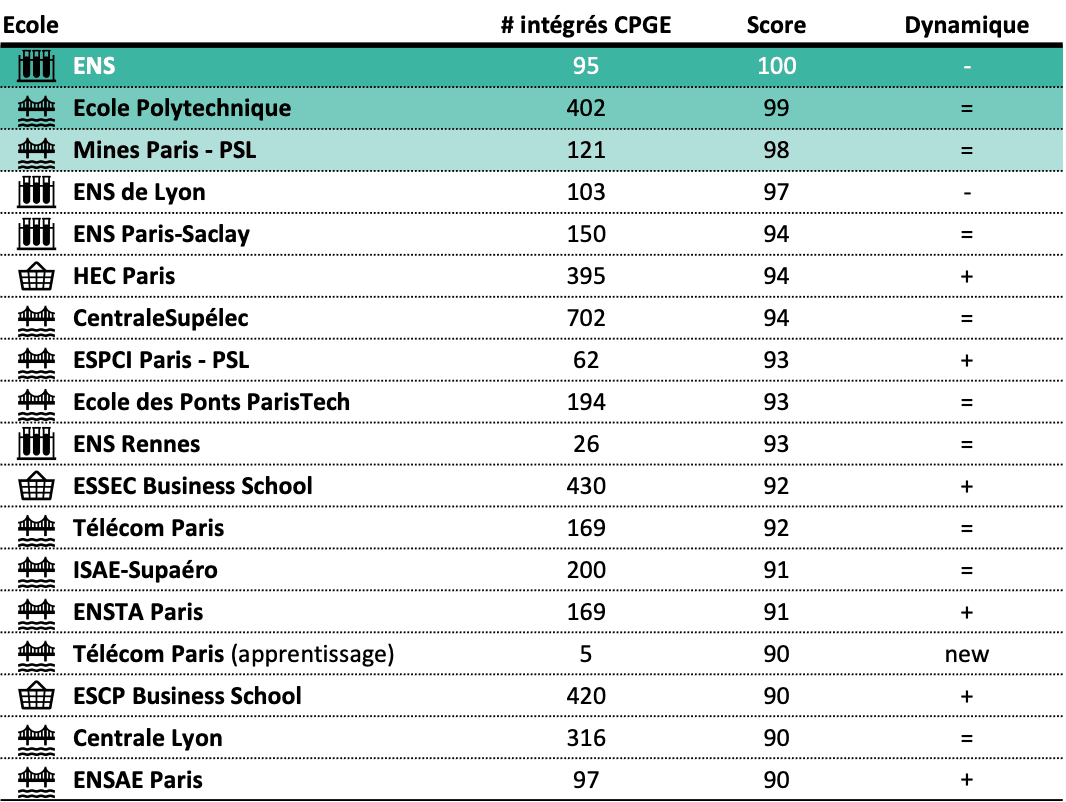
The following ranking therefore reflects only the choices of prépa students:
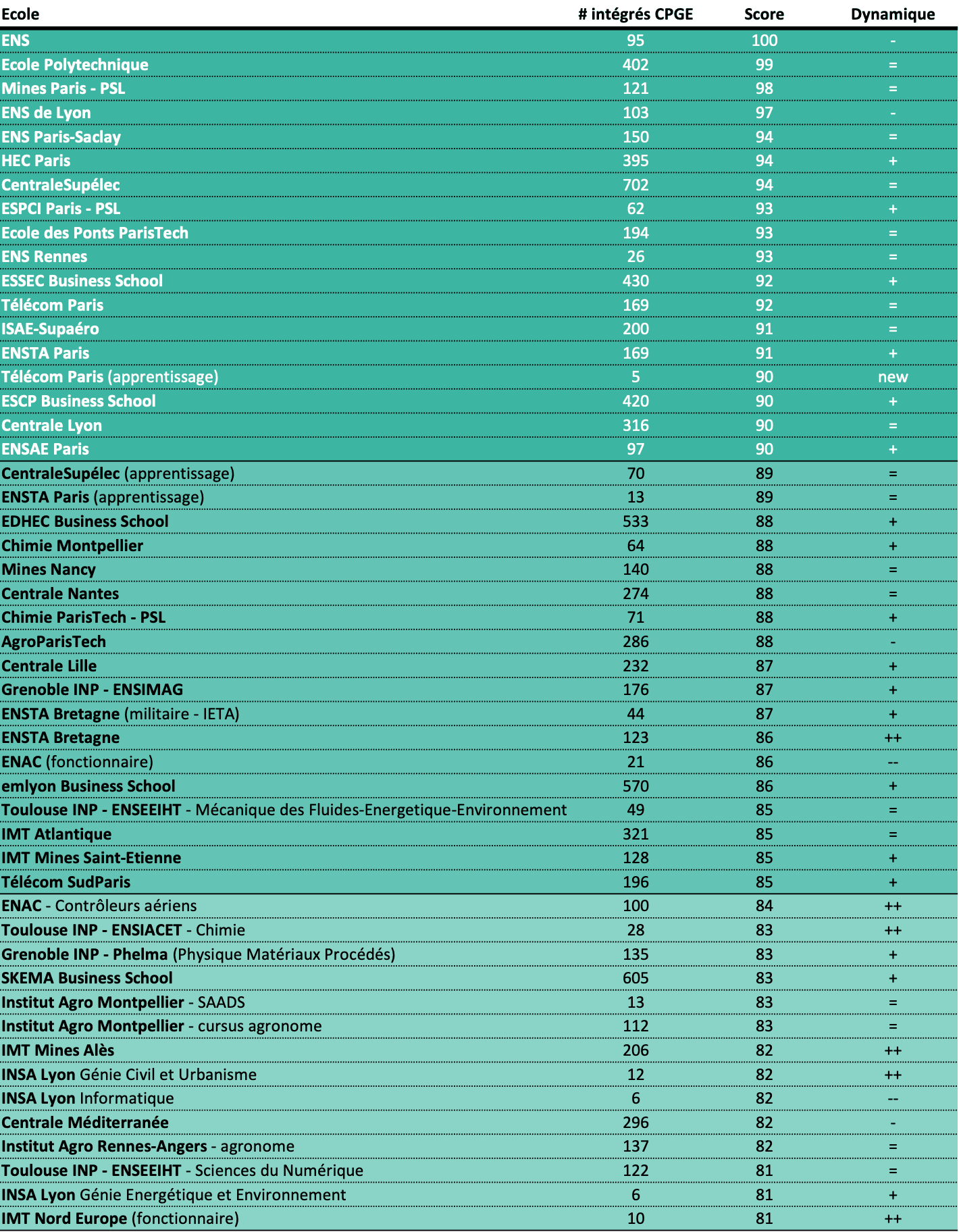
Top 50 sélectivité 2024
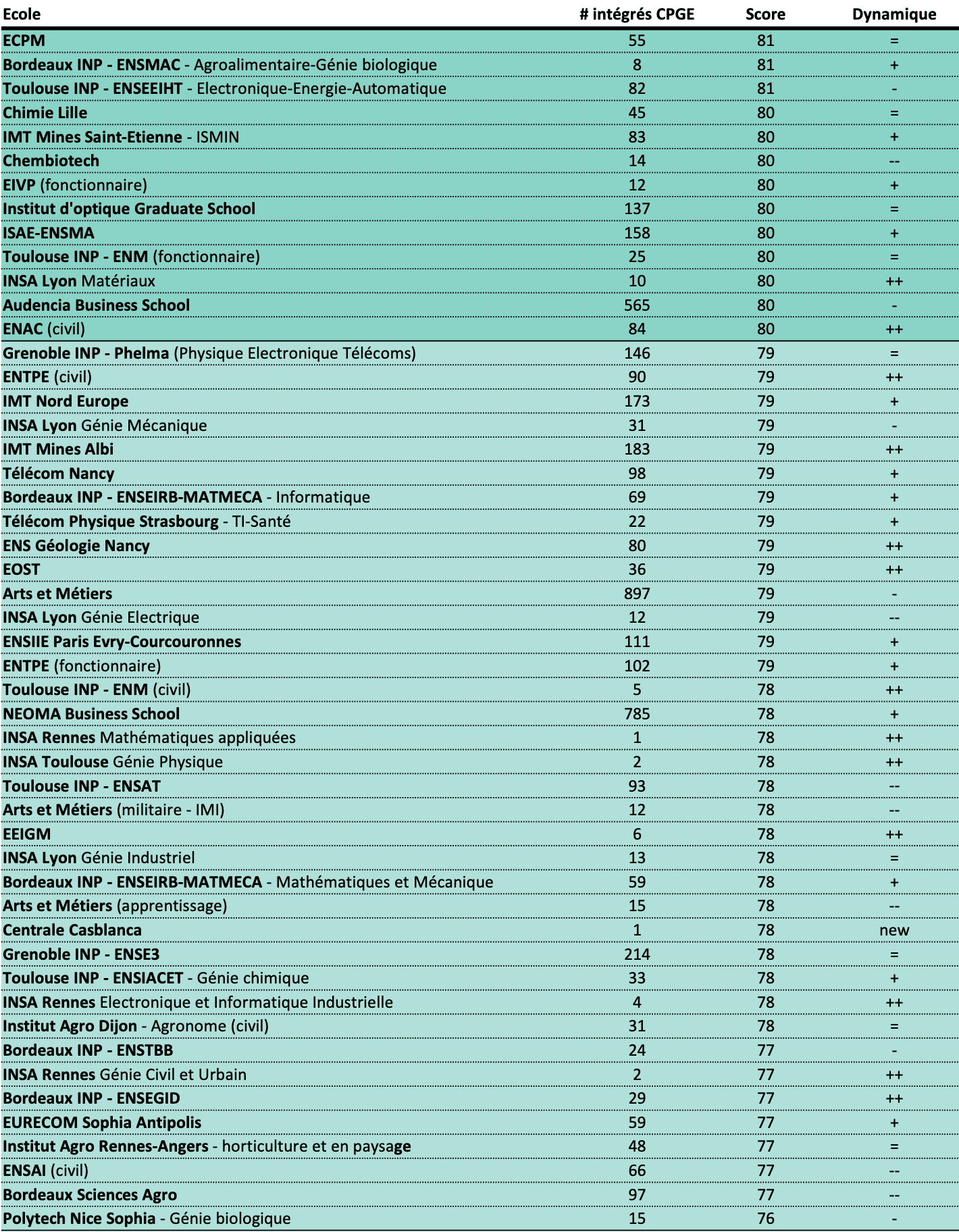
Top 51-100 sélectivité 2024
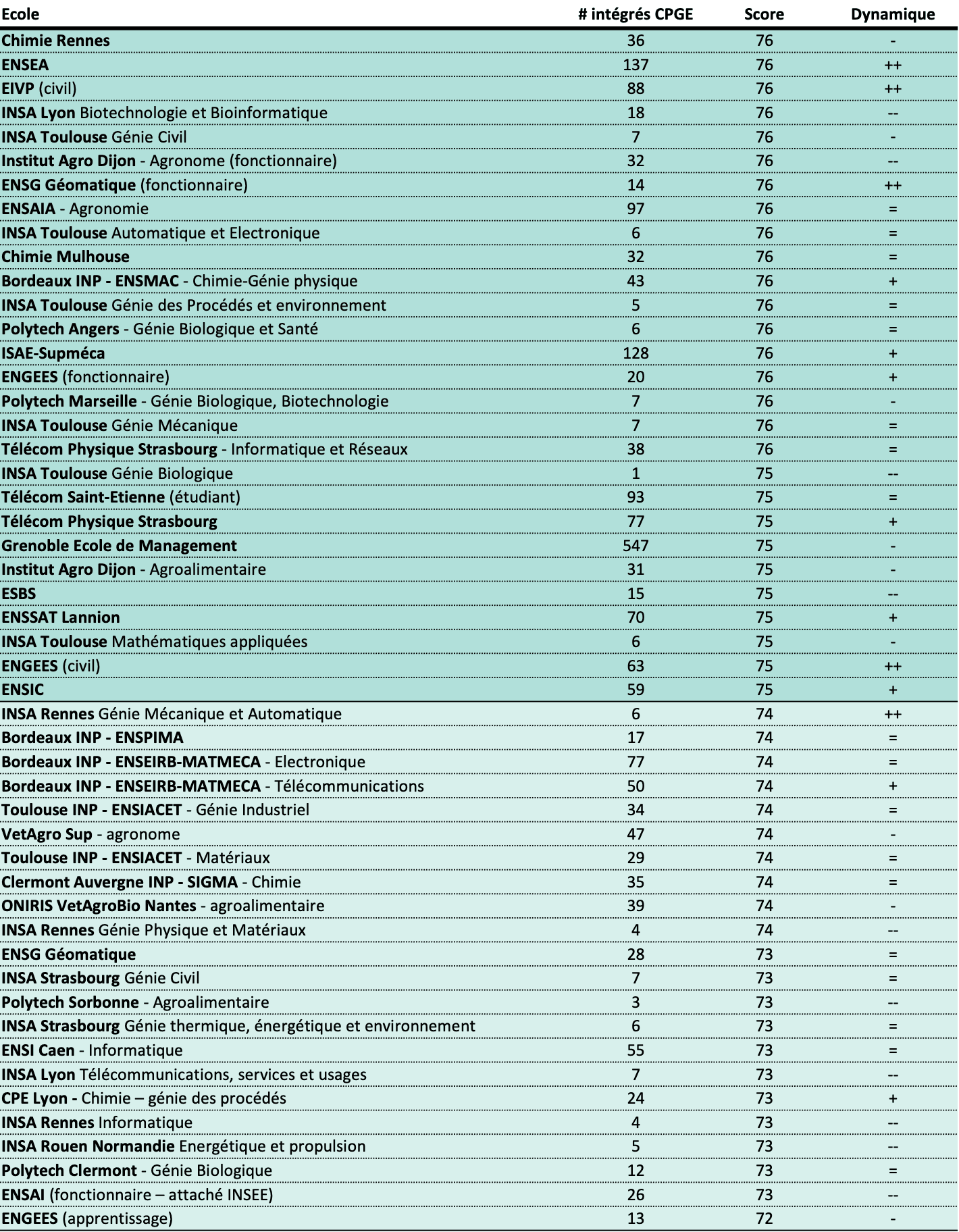
Top 101-150 sélectivité 2024
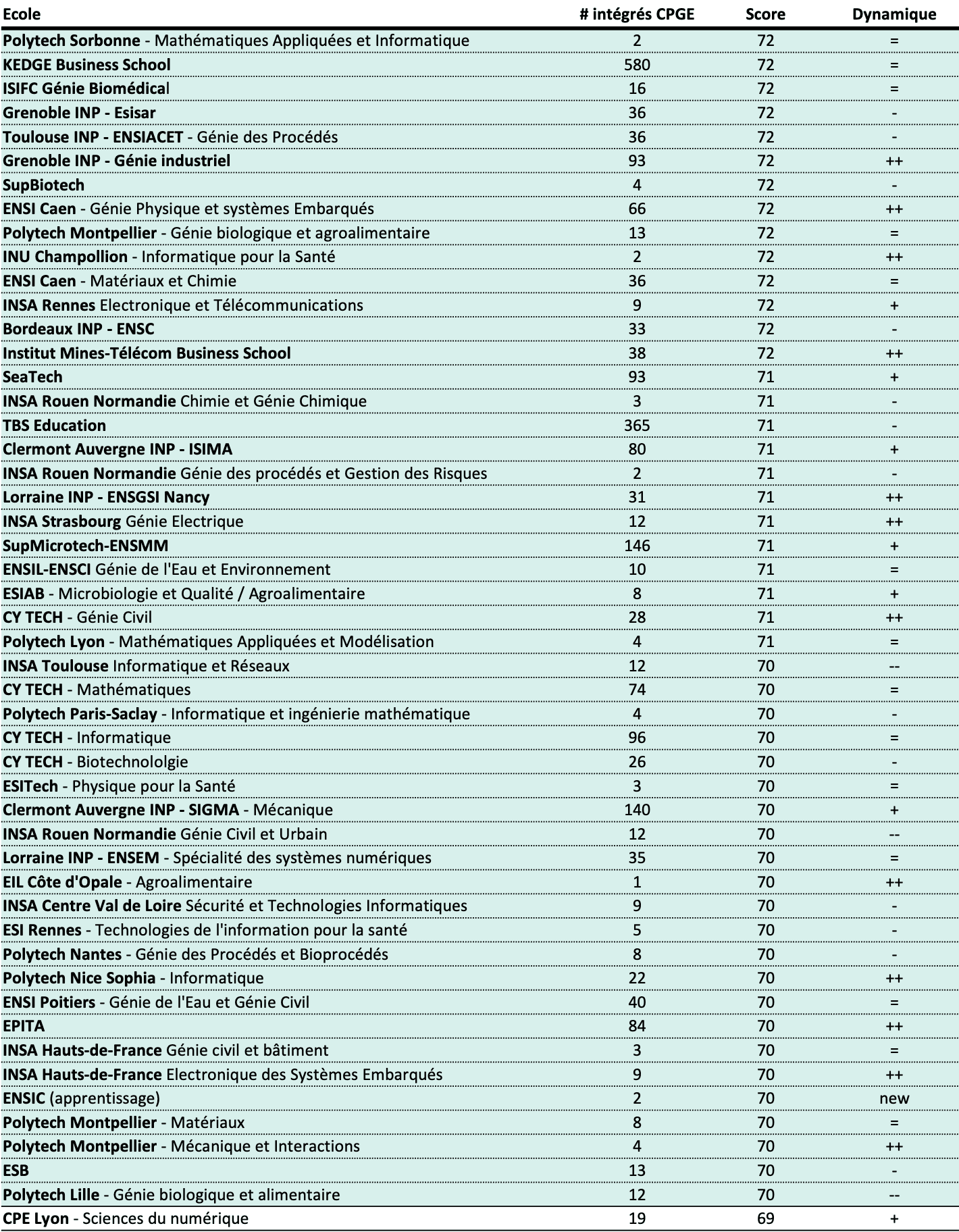
Top 151-200 sélectivité 2024
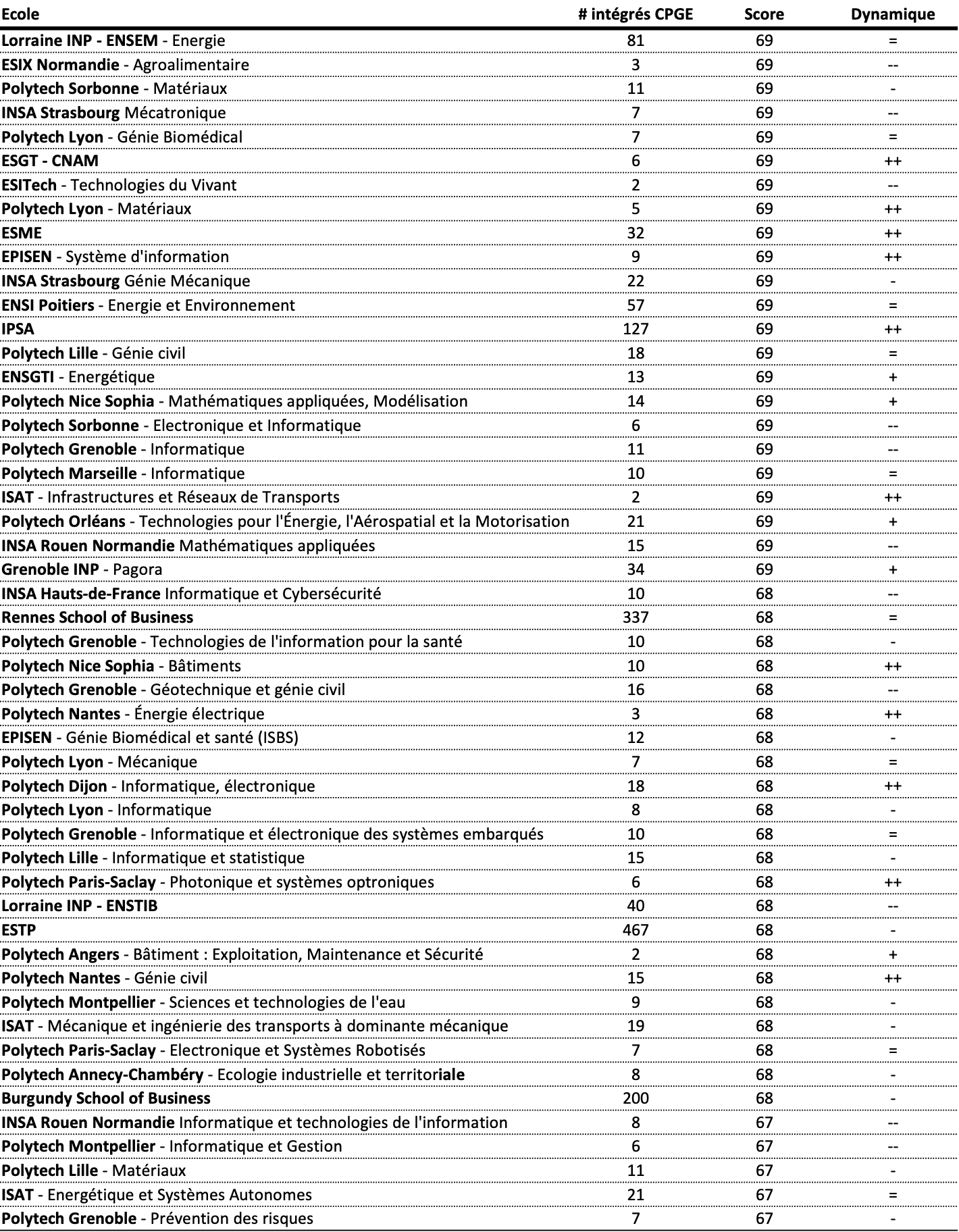
Top 201-250 sélectivité 2024
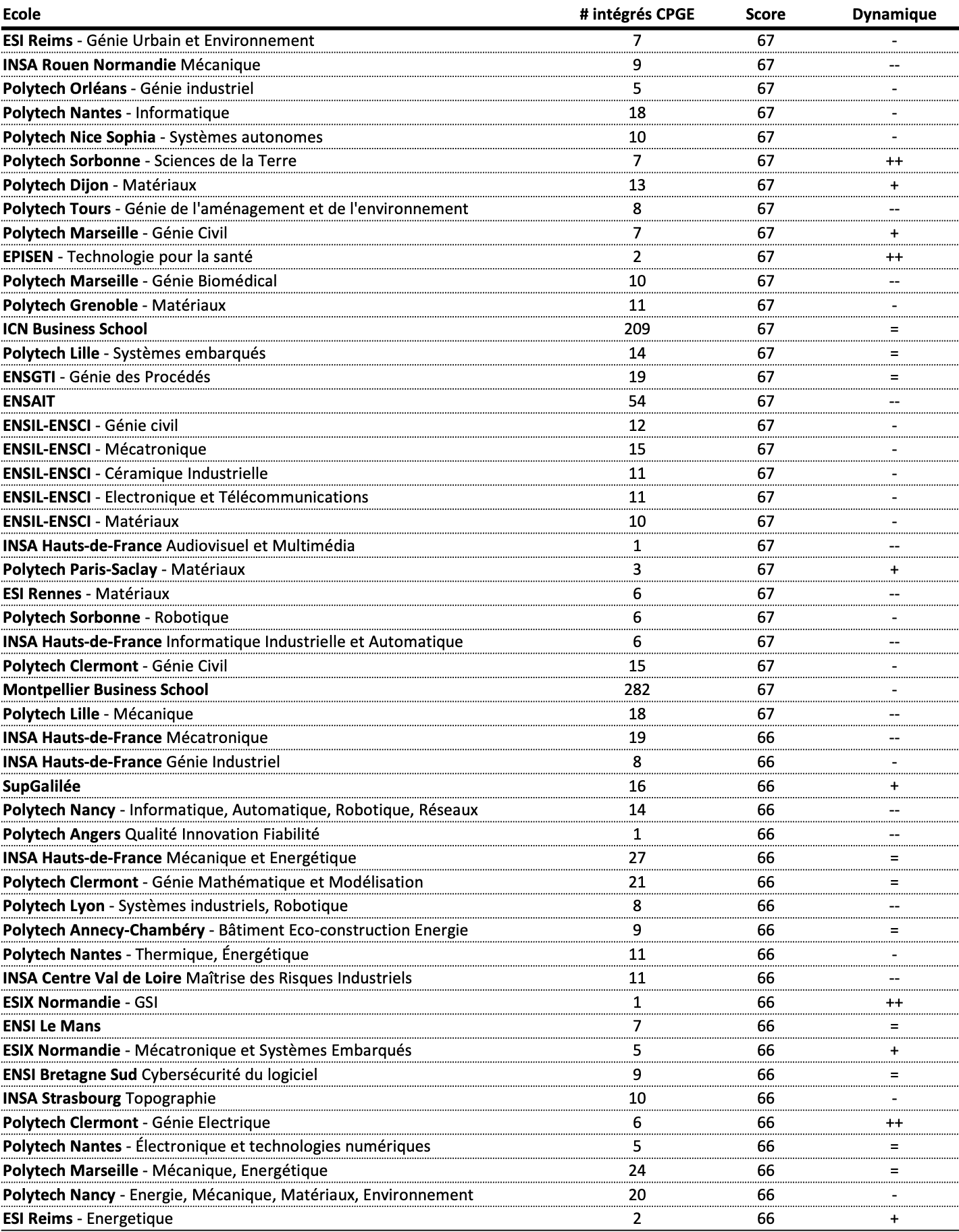
Top 251-300 sélectivité 2024
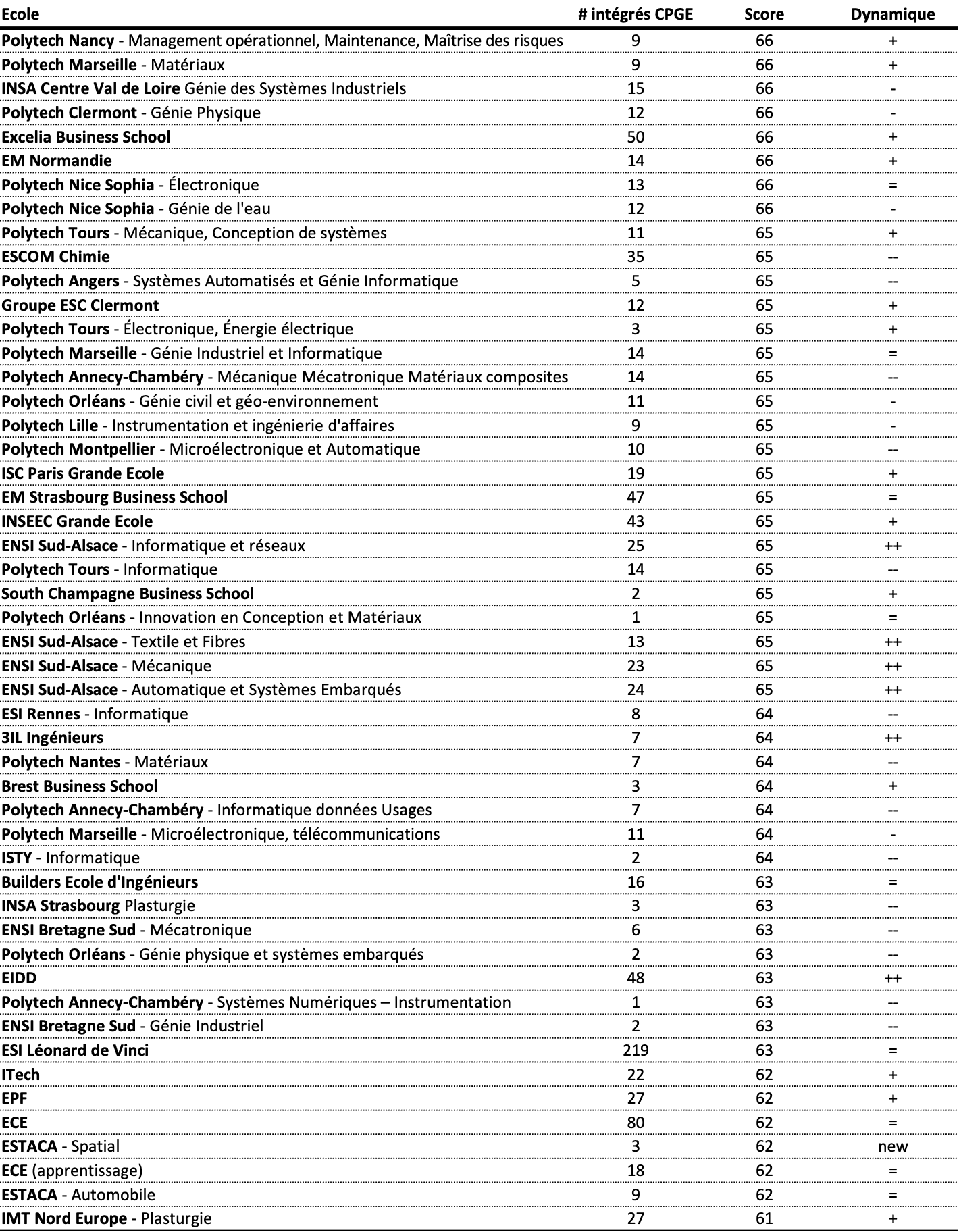
Top 301-350 sélectivité 2024
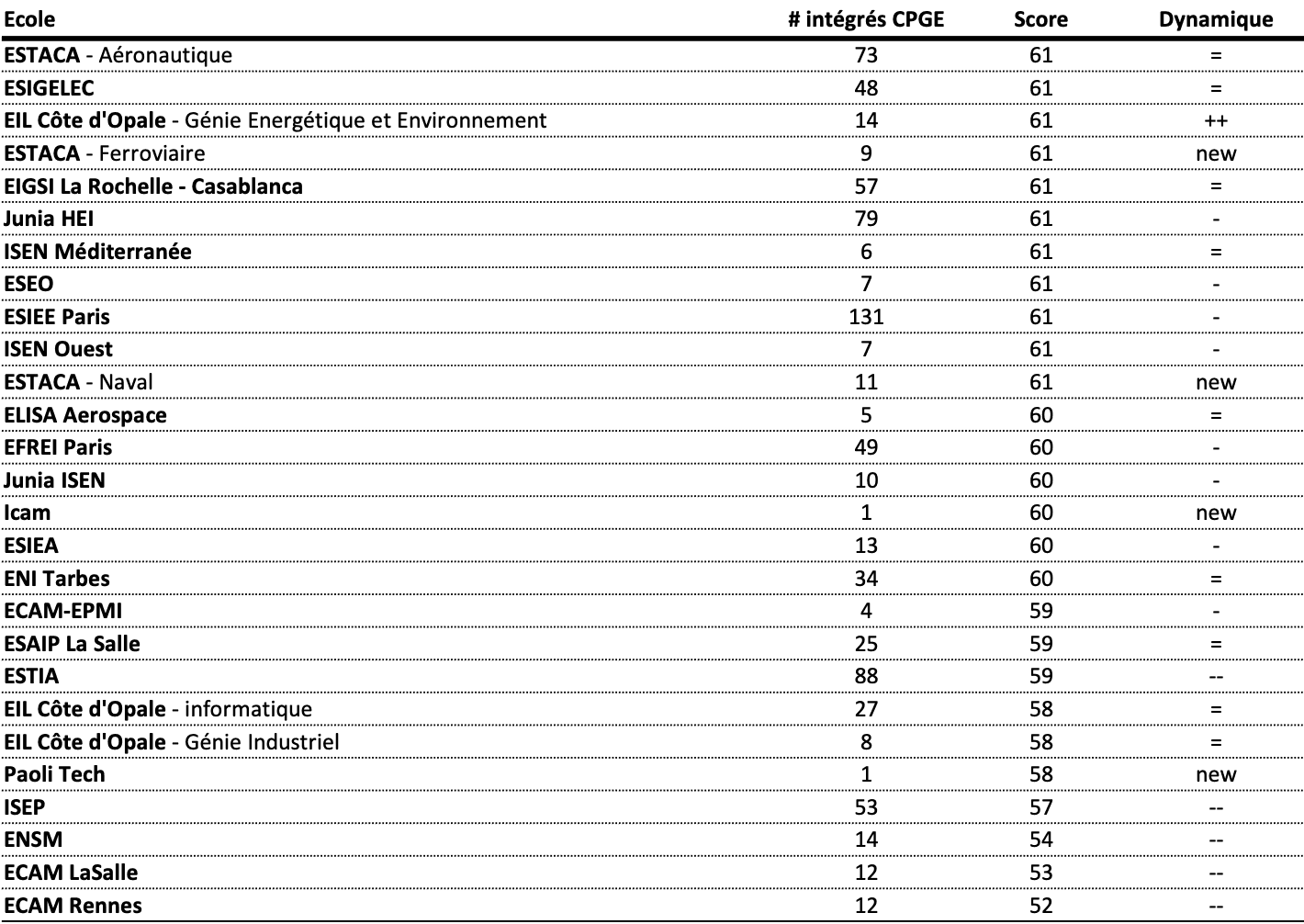
Top 377 sélectivité 2024
Methodology:
Definitions:
The study covers the exams of the preparatory classes for the grandes écoles (CPGE), indexed i: MP, MPI, PC, PSI, PT, TSI, TB, TPC, BCPST, BCE (ECG, ECT and B/L) and the INSA Group cross-track exam; P_i is the number of students enrolled in track i
Within each track, the exams are indexed j. In the MP track, for example: X-ENS, Mines-Ponts, CentraleSupélec, Mines-Télécom, INP, Polytech, Avenir Prépa, Puissance Alpha, Ingéni'Up and EPITA. The TPC track has a single exam. Q_(i,j) is the number of students registered for exam j in track k
Finally, the schools within an exam are indexed k.
Each school has three parameters:
b_(i,j,k): the average baccalauréat grade of the CPGE students admitted to school k (the same whatever the exam and the track)
m_(i,j,k): the average admission rank at school k through exam j in track i
e_(i,j,k): the number of students admitted to school k through exam j in track i
Starting assumptions:
The X-ENS, Mines-Ponts, CentraleSupélec and A Bio exams are assumed to be the best, and all the best candidates are assumed to sit them, so the average admission ranks of their schools are used unchanged.
For the other exams, two parameters are created: b_(i,j), an offset representing candidates who would rather repeat the year than enter a school through that exam and so do not sit it, and a_(i,j), a dilution factor representing exams with fewer schools, which some students choose not to sit. The adjusted admission rank is:
The Polytech cross-track exam is assumed to be uniform across the three tracks (MP, PC, PSI), so its rank is scaled in proportion to the number of candidates registered in each track, creating one Polytech exam per track.
Computing selectivity:
For each track I, the parameters are set automatically by solving a minimization problem, using least-squares projection parameters for the track (weighted by the number of students admitted to each school):
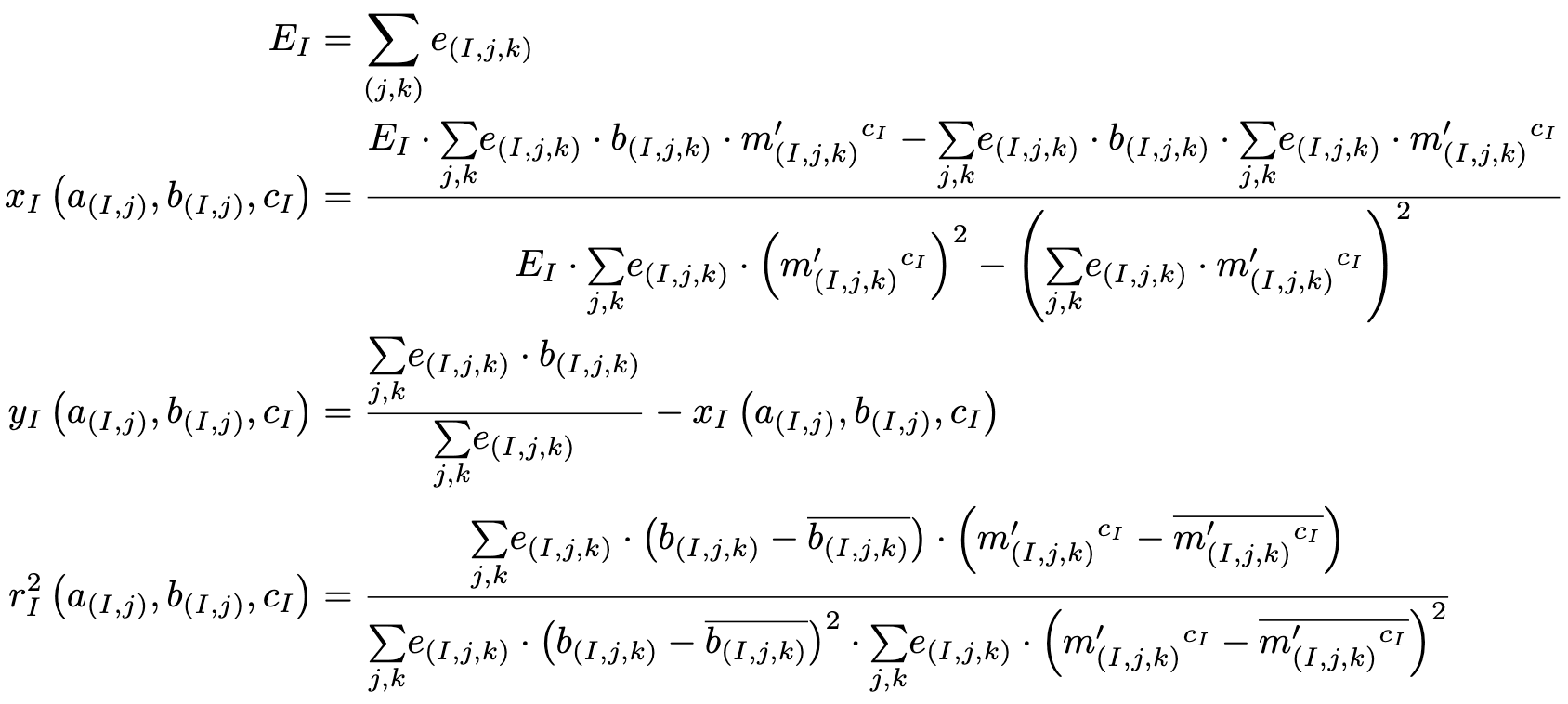
The problem to solve is therefore:
Note: the first two upper-bound conditions are not needed, since the third parameter condition already includes them. They are used to better constrain the optimization algorithm.
For a school K, the selectivity level is then: