
DAUR looks back at SIGEM 2024
This admissions season mostly cemented the positions of the schools that recruit from economics and business preparatory classes (ECG, ECT and B/L). It also saw many unfilled places: 6% of places went unfilled, and 14 of the 27 schools (excluding HEC Paris) did not reach their quotas.
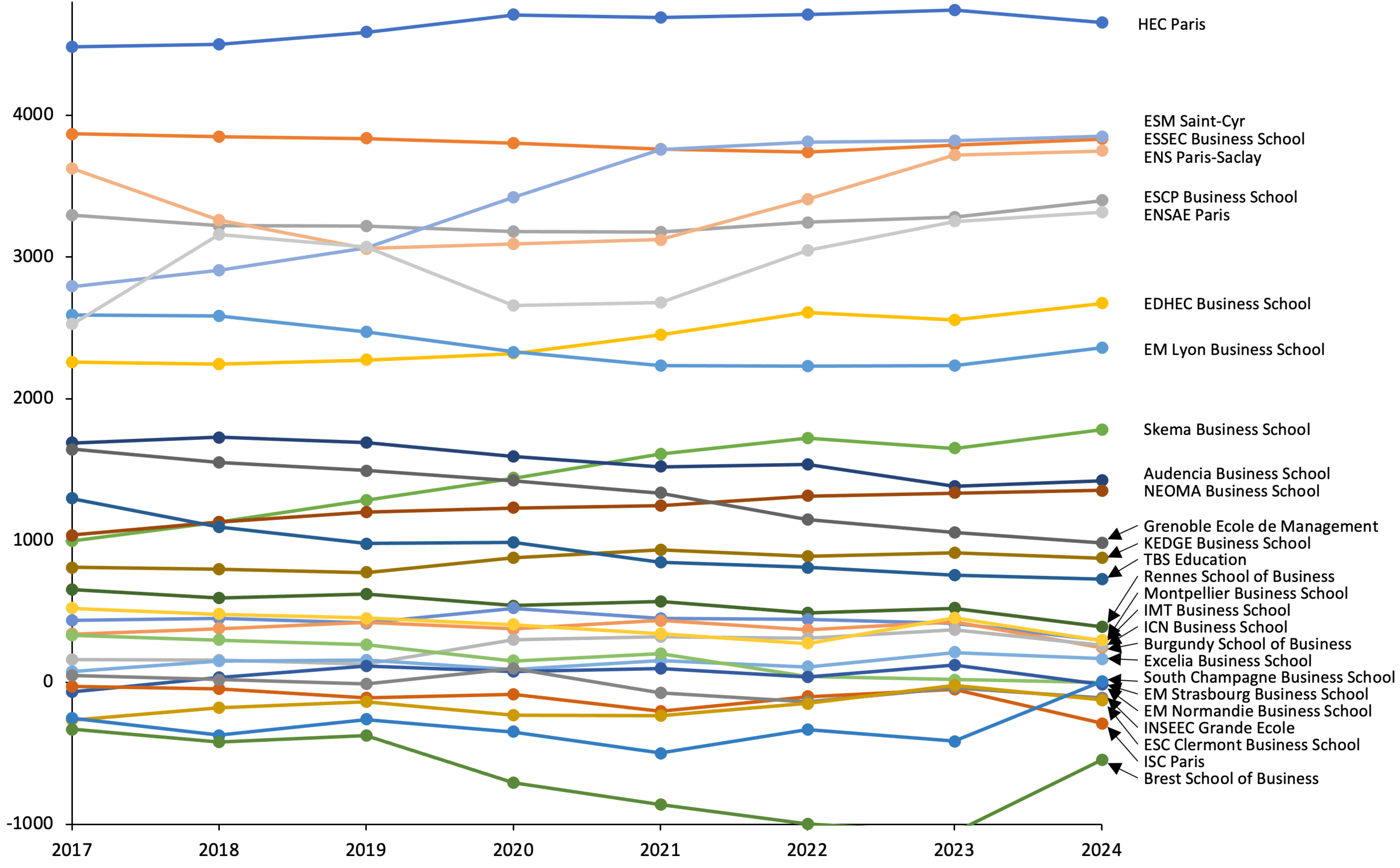
Historique SIGEM 2017-2024
The top 6 settles:
HEC Paris stays far ahead, with a 99% probability of being chosen over ESSEC;
ESSEC stays steady around 3,800, while ESCP is gradually catching up: the probability gap has narrowed by 33% over the last five years, with 20 withdrawals in favor of ESCP in 2024;
EDHEC confirms its 4th place with a record total score of 2,673 and an 86% probability of being chosen over emlyon;
Skema does not really threaten the top 5, with a 3% probability against emlyon, but it consolidates its 6th place ahead of Audencia and NEOMA with an 89% probability of being chosen.
Schools ranked 7 to 11, with interesting trends for 2025:
NEOMA has closed in on Audencia in recent years, with a probability of being chosen above 40% since 2023. Both schools are well ahead of the next ones;
Further back come GEM, KEDGE and TBS, in that order, with a possible contest between KEDGE and GEM as early as next year;
The schools at the bottom of the table are losing ground:
Rennes, Montpellier, Burgundy, ICN and IMT each lose more than 100 points (a drop of more than 28% in student preference);
Rennes and Montpellier still fill more than 90% of their places (92% and 96%), while the others fill 56% on average, down to 5% for South Champagne Business School;
Five years ago, the same schools filled 86% of their places, with more places available (1,525 in 2020 against 1,015 in 2024).
The other schools (ENS Paris-Saclay, ESM Saint-Cyr and ENSAE Paris) are increasingly popular:
ENS Paris-Saclay still offers 4 places to ECG candidates, and the number of candidates has grown by 32% (from 824 in 2021 to 1,034 in 2024). Its preference level now matches ESSEC's, and its selectivity sits between ESSEC and HEC;
ENSAE Paris is clearly turning toward the ECG exam, going from 15 to 20 places in five years, with 44% more candidates (from 599 in 2020 to 862 in 2024);
ESM Saint-Cyr attracts a steady number of students (216 in 2024 against 205 in 2020), with places limited to the top 42 in the exam. In 2024, the school drew high-level students, with candidates admitted to HEC Paris, ENS Paris-Saclay and ESCP turning them down for Saint-Cyr.
Attractiveness and selectivity:
SIGEM data shows the preferences of students admitted to two schools through the one they chose to enroll in. This measure has two biases:
Not every student applies to every school: only about 200 students apply to ESM Saint-Cyr, against more than 5,000 to HEC Paris. Some of these candidates may have been admitted to ESM Saint-Cyr and chosen HEC Paris, which would lower the military school's level.
A school that recruits many students can be preferred yet less selective than one that recruits fewer.
DAUR therefore offers two charts:
Attractiveness : based on students' cross-preferences, using an Elo algorithm to take every match into account, not only those on the diagonal (see https://www.daur-rankings.com/blog/sigem-2022 for more on the methodology).
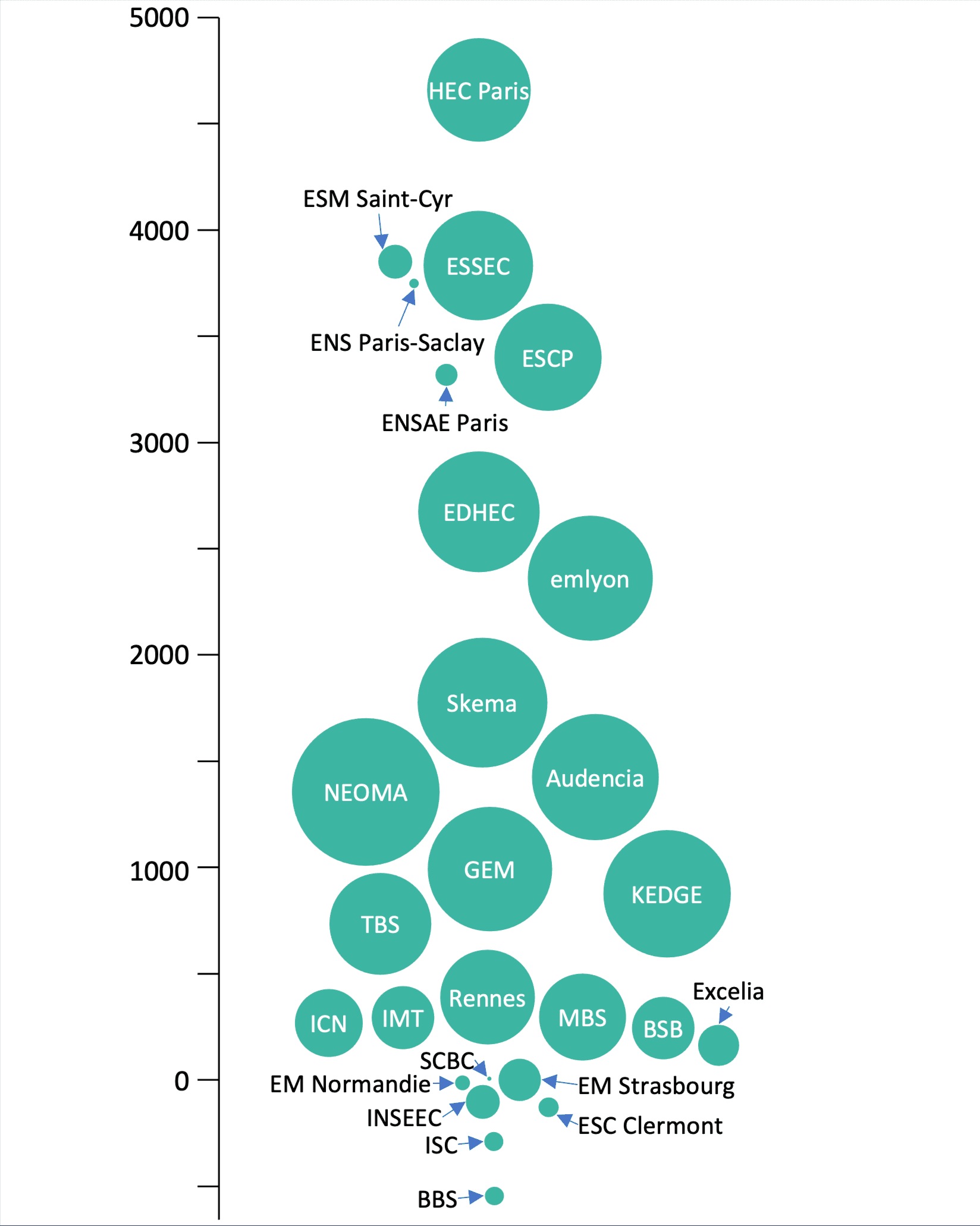
Attractivité SIGEM 2024 basé sur l'algorithme Elo, la taille des bulles est proportionnelle au nombre d'étudiants intégrés
Selectivity: simulates the results as if there were a single exam, taking students from the first-ranked to the last and estimating the probability that they registered for a school's exam and that they prefer that school. The simulation is run 10 times for reliable results.
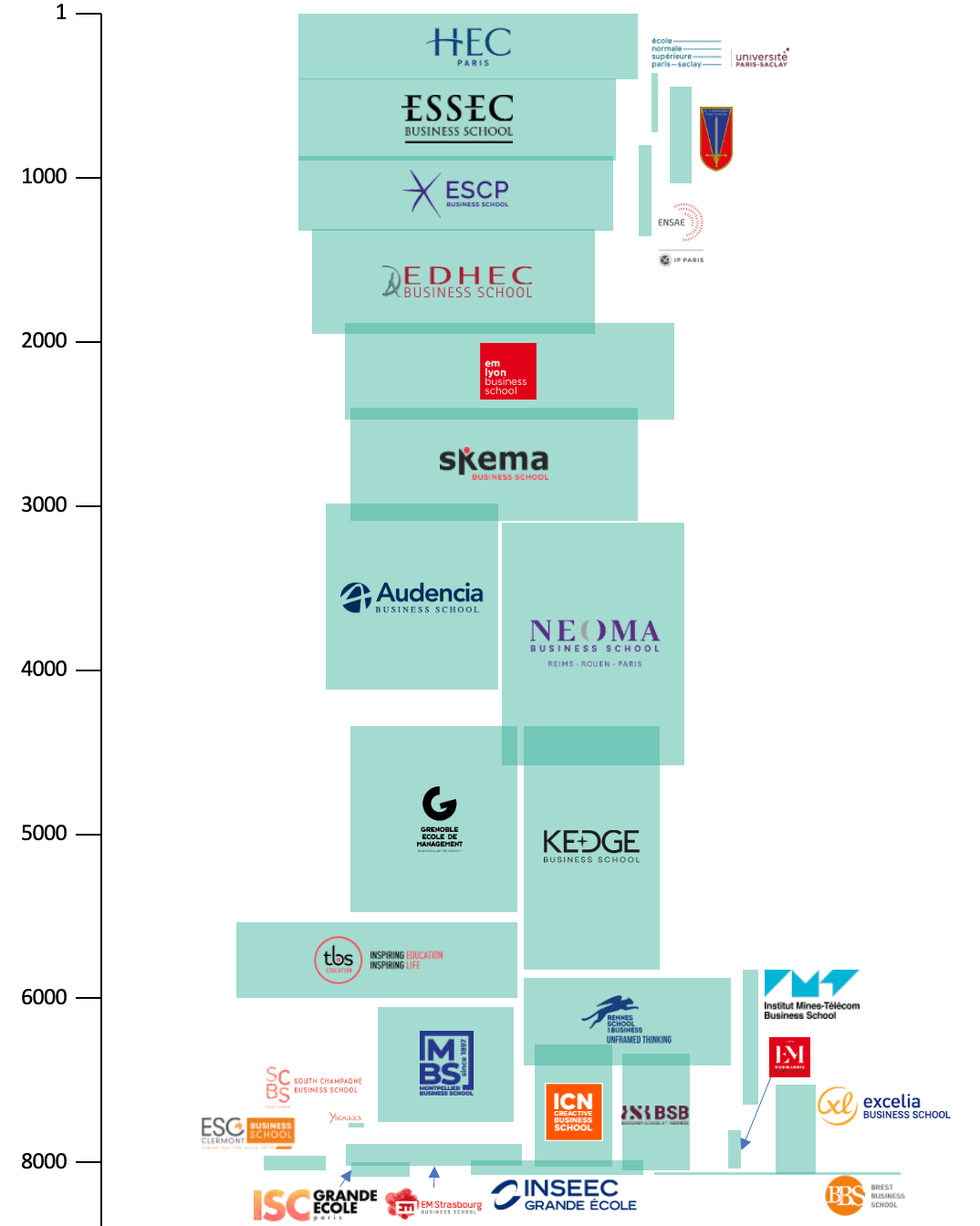
Sélectivité SIGEM 2024, à partir de la médiane de recrutement, le carré remonte jusqu'à 2 fois l'écart entre le Q1 et la médiane et descend jusqu'à 2 fois l'écart entre le Q3 et la médiane. La surface du rectangle est proportionnelle au nombre d'étudiants intégrés.
These charts put the gaps between schools in perspective. The preference data produces a single ranking of the 25 business schools: the top 5 between 1 and 2,500, the rest of the top 10 between 2,500 and 5,500, and the other 15 schools from about 5,500 to 8,000, which in the end recruit students of fairly similar level after prépa.