Ranking apprenticeship engineering programs: a major shift in technical higher education
Apprenticeships in engineering schools have grown fast in recent years, with an increase of 8.4% a year in the number of graduates, from 7,518 in 2021 to 9,591 in 2024, according to CTI data. Schools are adapting to employers, who want engineers trained on the job.
Wider recruitment
Apprenticeships used to be reserved for students admitted on the basis of their diploma (mainly from BUT and BTS programs). They now also reach students from preparatory classes for the grandes écoles (CPGE), through dedicated exams. In 2024, this meant 187 students admitted directly (+40% compared with 2023, excluding Centrale Méditerranée and IOGS) to apprenticeship programs through these exams. The latest schools to open one: ESIEE in 2024, Télécom Paris in 2023, ECE in 2020, ENSTA Paris in 2019, Arts et Métiers and CentraleSupélec in 2018, Télécom Saint-Étienne in 2016 and ENGEES in 2011. New programs arrive in 2025: EIVP, Polytech Marseille, Polytech Nice-Sophia, EPITA, IPSA and ESME
Recruitment strategies
Schools follow four main recruitment strategies:
Dedicated recruitment through a post-CPGE exam: schools such as ENSTA Paris, CentraleSupélec, ENGEES, Télécom Paris and others have set up dedicated recruitment into apprenticeship programs through recent CPGE exams, with the same degree for students and apprentices.
The same recruitment for students and apprentices: schools such as Centrale Méditerranée and the Institut d'Optique Graduate School award a single degree, whichever route students take.
Recruitment after a BUT or BTS for specialized degrees: some schools offer highly specialized programs, such as Centrale Lyon (energy), Mines Paris (energy) and ISAE-Supaéro (industrial engineering).
Shared recruitment after a BUT or BTS: groups such as INSA and IMT have pooled their recruitment, making it easier to join an apprenticeship program after a BUT or BTS.
A ranking of apprenticeship engineering programs
The DAUR 2025 ranking of apprenticeship engineering programs uses DAUR's new algorithms with six main criteria: average level, selectivity, attractiveness, employability, research and entrepreneurship. It is the same method DAUR has used for its engineering and business school rankings since it was created. The ranking shows some interesting trends in school strategies:
ENSTA Paris comes first thanks to a high academic level: it is the top apprenticeship program for selectivity and average level, and second for attractiveness. It also has high employability (5th)
CentraleSupélec comes second, with the highest attractiveness score
The Institut d'Optique completes the top 3, with the highest research score
Centrale Méditerranée, Arts et Métiers et Télécom Paris follow
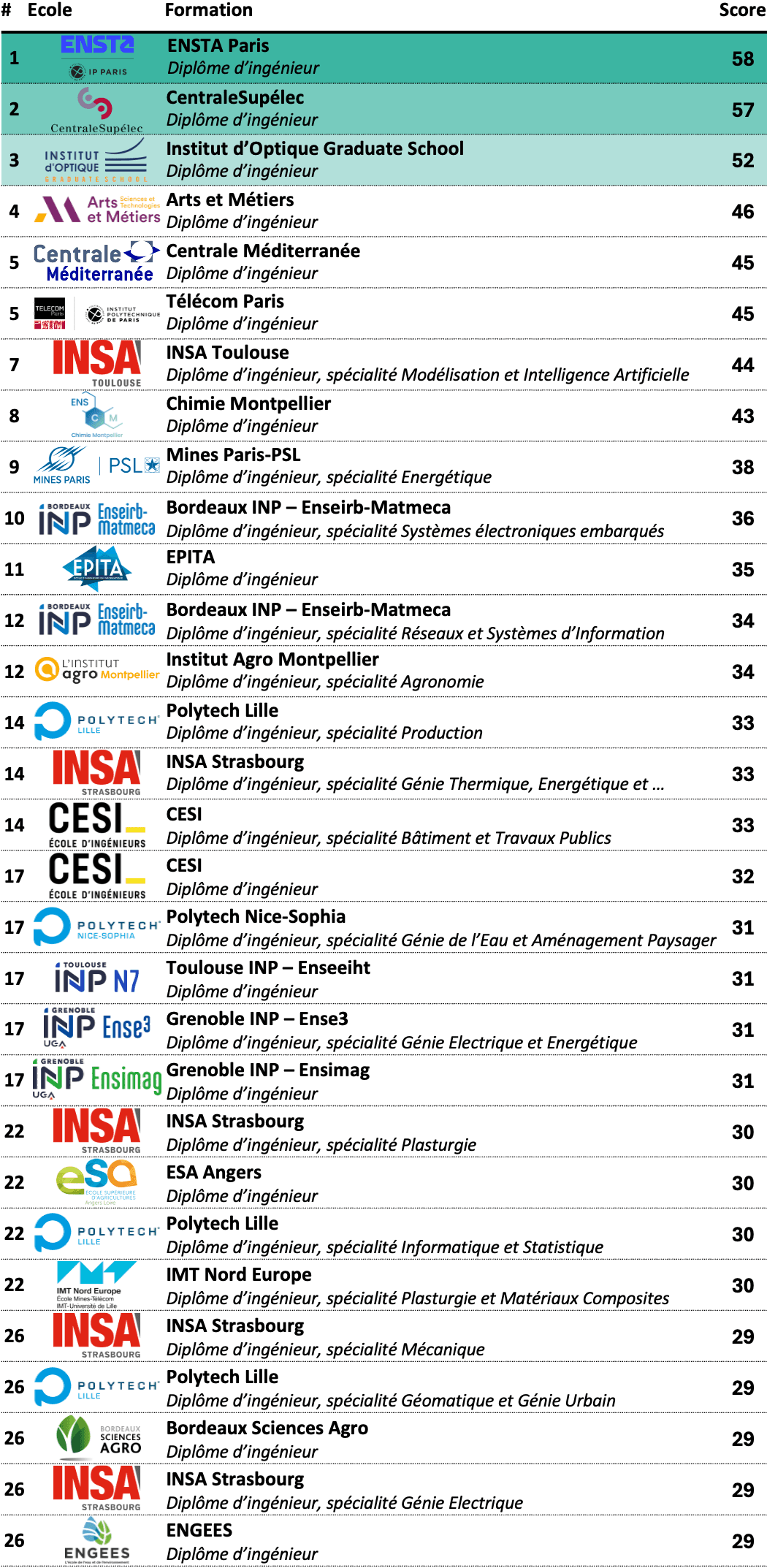
2025 Ranking of top 30 French Master of Sciences in Engineering by apprenticeship among 210 ranked
A first-of-its-kind analysis of more than 600 engineering programs
The DAUR ranking is the only ranking that ranks programs rather than just schools. It is also the only one to rank students and apprentices on the same criteria, which gives a fuller and fairer picture of engineering programs in France.
The ranking applies a single methodology to every program, using data from the CTI and the CDEFI. It covers 632 programs, grouped into specific sectors this year after an in-depth review of every program's syllabus, rather than relying only on RNCP records, Formacode codes and NSF codes. Every program is assessed on strict, comparable criteria, for full transparency and reliability for students and recruiters. The new ranking will be published gradually from next week.
With this analysis, DAUR wants to give future engineers, apprentices and students alike, a complete and reliable assessment of engineering programs, and to help schools adjust their strategies to what students and employers expect.