
A detailed study of strategy consulting in Europe and of the education of the senior staff of the leading firms.
The database is a list of 1,321 partners at the three main strategy consulting firms.
Partners here means Partners, Senior Partners, Senior Advisors, Directors and Senior Directors at McKinsey, BCG and Bain. Each listed partner is linked to an office, and all their degrees (bachelor's, master's and doctorates) are recorded.
The analysis focuses on European countries, but countries bordering Europe or economically close to it are also included.
The study covers 58 states. For the analysis, they were grouped into clusters by geographic proximity and historical and economic similarity.
The 13 clusters studied:
Central Europe as defined by Milan Kundera: Hungary, Austria, the Czech Republic, Slovakia and Poland;
The Near East: Egypt, Israel, Palestine, Lebanon, Syria, Jordan, Turkey, Iraq and Cyprus;
Eastern Europe in its narrow definition: Russia, Belarus and Ukraine, plus Moldova, Kazakhstan, the Caucasus countries (Armenia, Georgia and Azerbaijan) and the Baltic states (Estonia, Latvia and Lithuania);
The Balkans in the geographic sense: Albania, Bosnia and Herzegovina, Bulgaria, Greece, Kosovo, North Macedonia, Montenegro, Croatia, Serbia, Slovenia and Romania. Italy and Turkey are left out of this cluster even though part of their territory lies in the area;
Scandinavia, defined as the members of the Nordic Council of 1952: Iceland, Norway, Sweden, Finland and Denmark;
The Maghreb, defined as the members of the Arab Maghreb Union: Morocco, Western Sahara, Algeria, Tunisia, Libya and Mauritania;
Benelux, based on the 1944 Benelux treaty: Belgium, the Netherlands and Luxembourg;
The Iberian Peninsula: Spain and Portugal;
The British Isles: the United Kingdom and Ireland;
Italy, Germany, France and Switzerland are clusters of their own;
Microstates are excluded from the study: the Vatican, Andorra, Liechtenstein, Monaco, San Marino and Malta.
Higher education systems are not equal, and some prove more attractive than others.
24% of the partners also chose to earn degrees outside Europe, and 7% hold no degree from a European institution.
Number of graduates who are partners in a European office, per million inhabitants, for European countries.
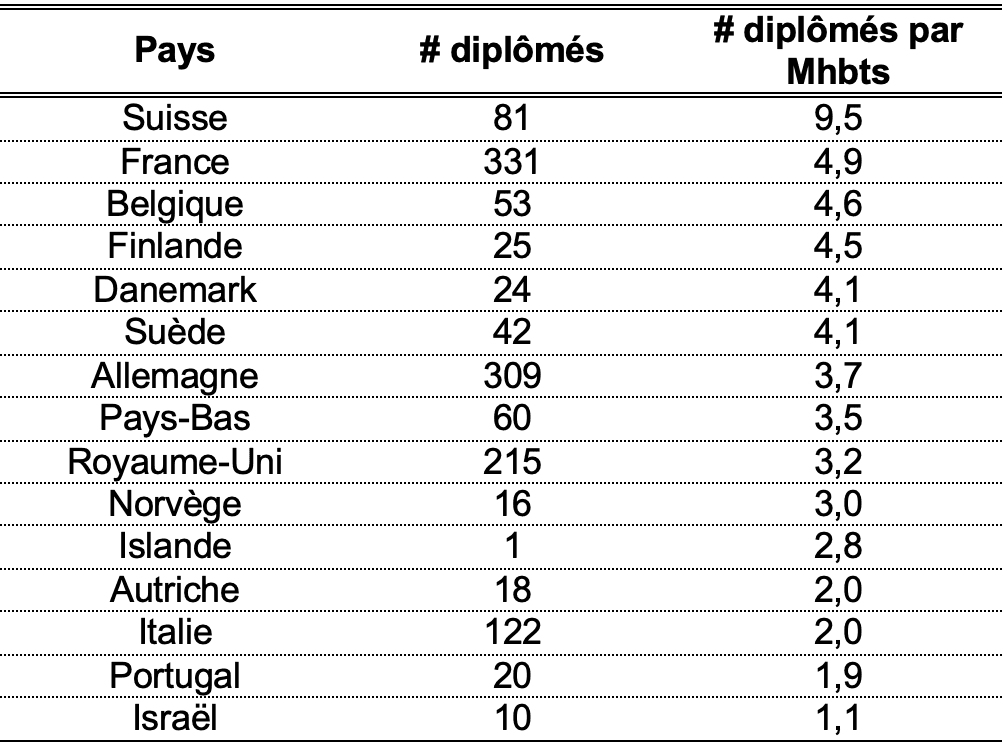
Source : Pays d’obtention des diplômes des différents associés et population en 2018 selon la Banque Mondiale.
Relative to their size, some countries' education systems perform strongly. Switzerland in particular is ahead of every other European country, with a very high number of graduates per million inhabitants. This comes from two effects:
1. Universities that go international to attract the best foreign students: internationally visible institutions with programs in line with international standards (Bachelor, Master of Science, MBA, …) and much of the teaching in English.
This is the case in Benelux, the British Isles and Switzerland, with institutions such as the University of Cambridge, the University of Oxford, ETH Zürich, KU Leuven and Erasmus Universiteit Rotterdam.
2. High-level preparation before university or school: the Scandinavian countries stand out for their very strong secondary schools. Denmark, Sweden and Finland are all in the top 5 of the countries studied for combined PISA reading and mathematics scores.
Other countries stand out for an unusual and demanding higher education system, such as the French preparatory classes, which build a strong capacity for work and more uniform profiles in the schools.
The United States has 271 graduates who are partners in a European office and ranks third by raw number of graduates. This shows how attractive the American system is beyond its own continent, thanks to the international reputation of its top universities. Beyond the MBA programs of the best-known schools, such as Harvard Business School, Wharton, Columbia Business School or the Kellogg School of Management, which are among the programs European partners chose most, some took more varied paths less aimed at strategy consulting, such as a Master in Public Policy (MPP) or a Master of Science (MSc).
The MBA stands out as the most relevant degree for strategy consulting, even though there are alternatives.
The Master of Business Administration is the degree most partners hold.
Nearly 40% of partners in Europe hold an MBA. The ratio varies significantly from country to country, though.
In the Iberian Peninsula and the Near East, more than 70% hold an MBA, while in offices in Germany and the Scandinavian countries the share is below 20%.
Offices in some countries put more weight on doctoral degrees.
More than 20% of partners hold a doctorate, but how much consulting firms value one varies widely by country: more than 50% of partners in Austria and Germany hold one, against fewer than 5% in southern countries (the Maghreb, France, the Near East, the Iberian Peninsula and Italy).
How the academic profiles of European partners vary by country.
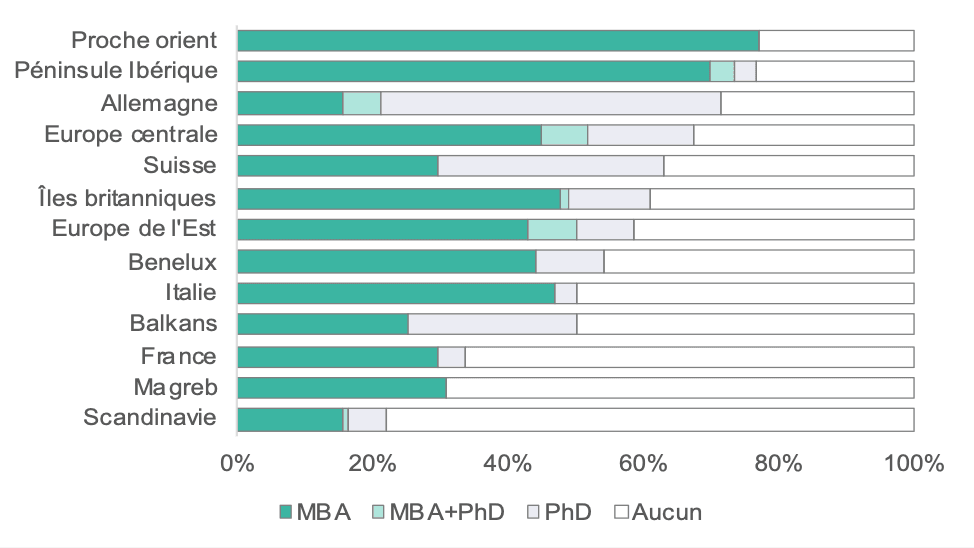
Source : Analyse menée sur les parcours académiques des associés en fonction du pays de leurs bureaux.
The education level of its senior staff shows how demanding strategy consulting is: nearly 60% of them hold an MBA or a doctorate.
Some degrees, usually from each country's best-known institutions, do not need an MBA or a PhD on top.
Graduates of French schools need to add to their first degree less often to become partners at the big firms.
Countries of origin of degrees not followed by an MBA or a PhD.
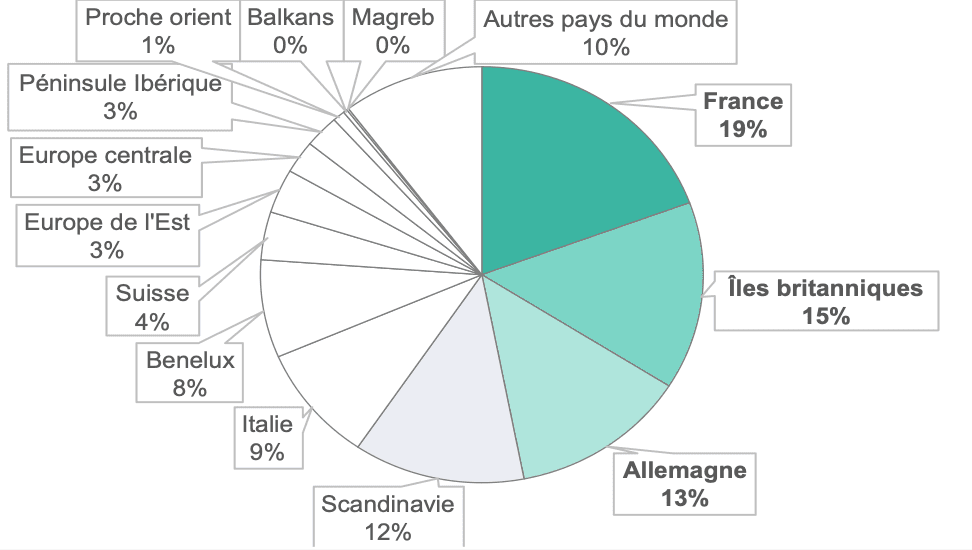
Source : Pays de diplomation des associés n’ayant obtenu ni MBA, ni PhD.
Three models of education (correlated with the country where the degree was earned) stand out among European partners.
The Latin model:
Partners from schools offering very selective master's-level programs, such as École polytechnique, Università Bocconi or HEC Paris. These partners usually do not take further degrees. The model is mostly associated with two fields: engineering and management.
The model is especially common in France and Italy, but schools built on it have appeared in many European countries (mostly business schools).
In Germany, WHU-Otto Beisheim School of Management offers a small number of Master of Science programs with very selective admission criteria. Others include Copenhagen Business School in Denmark, the Stockholm School of Economics in Sweden and WU Wien in Austria.
The Germanic model:
Partners from large universities who usually studied at a single institution, from bachelor's to doctorate. Nearly 70% of the partners who studied only in Germany finished with a doctorate. As in the Latin model, the great majority of doctorates earned in Germany are in management, economics or engineering.
Doctoral fields of partners who did all their studies in Germany.
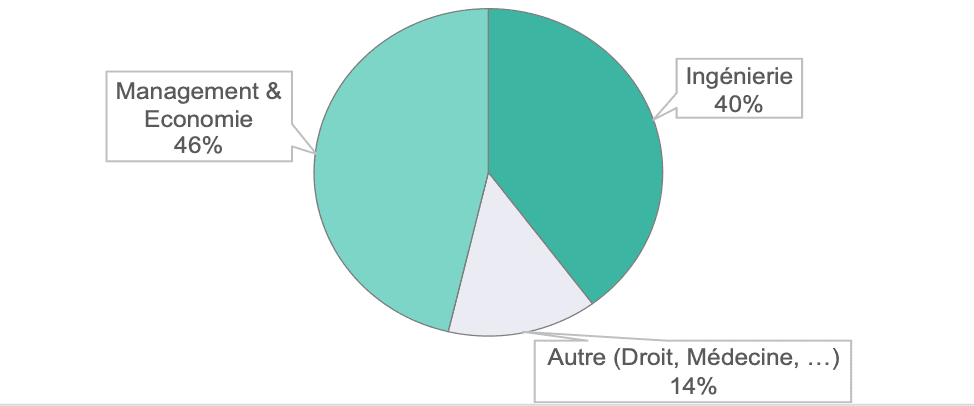
Source : Thèmes de thèse des associés ayant effectué la totalité de leurs études en Allemagne.
This model is found across Europe in large multidisciplinary universities, notably KU Leuven in Benelux and ETH Zürich in Switzerland.
The Anglo-Saxon model:
Education at universal institutions whose alumni come from a wide range of fields (history, law, political science, engineering, natural sciences, medicine, …). These universities teach every subject, and their degrees are usually not followed by an MBA or a PhD.
These universities also attract students who started their studies in other countries and want to add a master's or a doctorate.
The model is led by the two main English universities: the University of Oxford and the University of Cambridge.
Students who did not start with a program that fits one of these models almost always add an MBA.
Some programs and universities also stand out for the number of partners they produce, a sign of high-level teaching and a strong reputation.
The MBAs that produce the most partners rank among the best MBAs in the world according to DAUR-rankings. American programs are the most sought after, even in Europe.
Where the partners earned their MBAs.
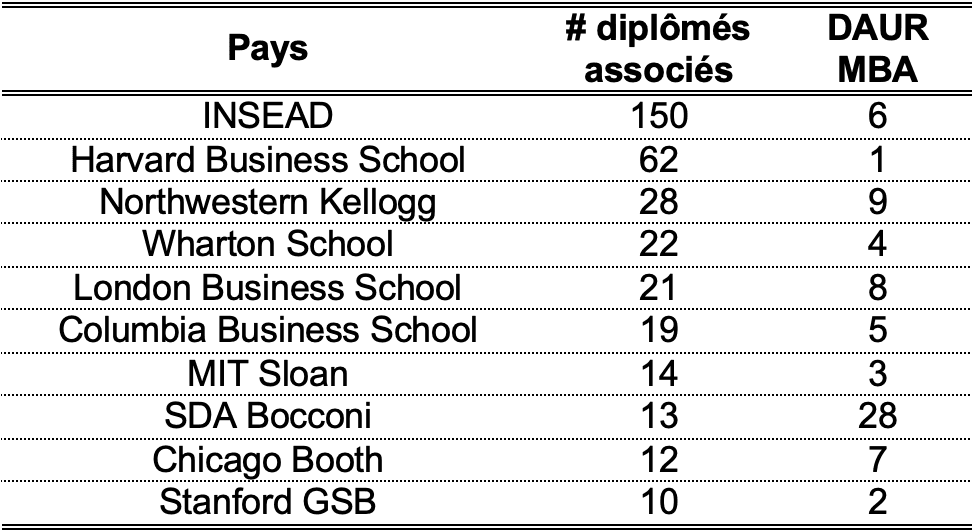
Source : Parcours des associés de McKinsey, BCG et Bain en Europe.
The MBA was created in the United States by Harvard University in 1908. It spread widely there over the 20th century and became the main post-bachelor degree. The first European MBA was taught by the Institut européen d'administration des affaires (INSEAD) in 1957, founded on the same model by former Harvard Business School students and faculty.
Teaching quality counts in assessing an MBA, but its main selling point is the alumni network. Combined with their history and their specialization in this degree, this explains why American business schools outperform the rest of the world.
Institutions of the Germanic model perform well and attract students for doctorates, with 7 of the top 11 universities.
Where the partners earned their PhDs.
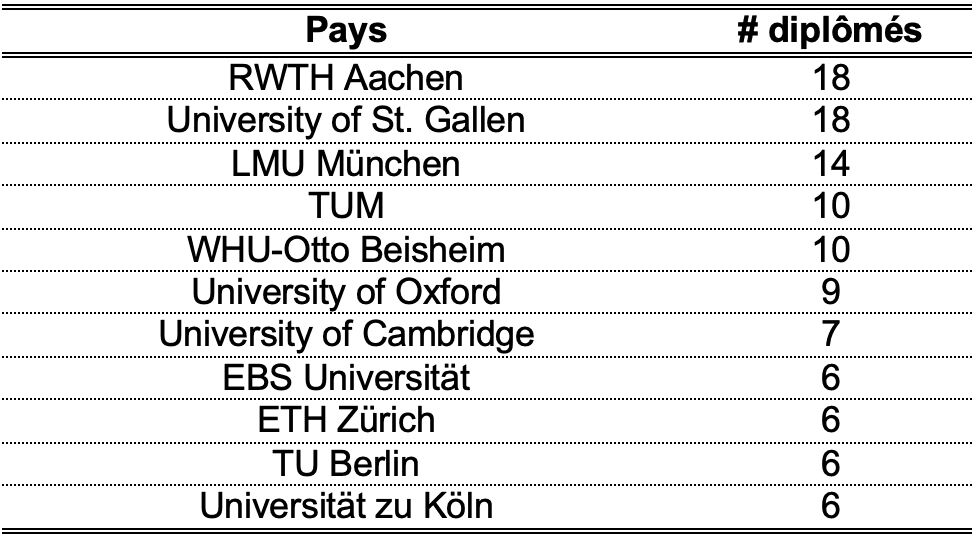
Source : Nombre de PhD par université.
Leaving MBAs and PhDs out of the study, the first degrees with the highest total scores all come from the 3 models described above.
The institutions with the highest scores include the best schools according to DAUR-rankings (HEC, Oxford, Cambridge, Bocconi, St. Gallen, LSE, ESSEC, CBS), all eight of which are in the top 10 European business schools of 2020 (https://www.daur-rankings.com/rankings/business_school/2020).
Scores of European institutions, excluding MBAs and PhDs.
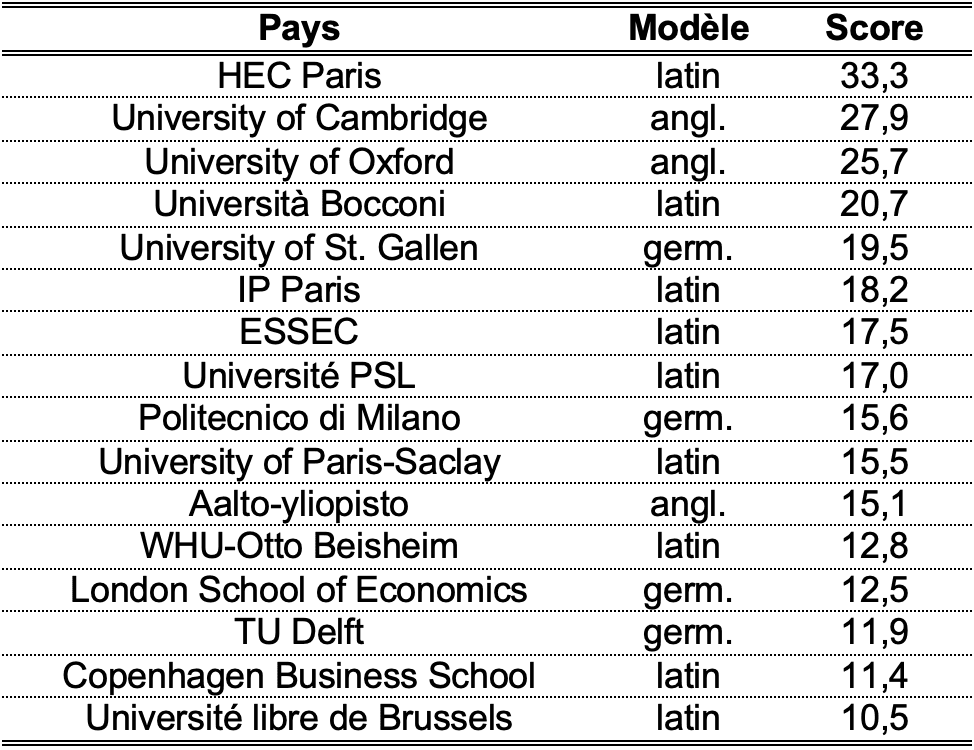
Source : Parcours des associés de McKinsey, BCG et Bain en Europe.
The United Kingdom's offering is very unbalanced. The University of Oxford and the University of Cambridge are among Europe's leaders in every field. To a lesser extent, the London Business School MBA and the first degrees of the London School of Economics also do well. The other British institutions are much further behind.
With 5 institutions in the top 10, France shows that the model of preparatory classes and admission by competitive exam leads to high-level education and good career outcomes.
Looking more closely, French higher education is made up of schools of very different sizes (from Sciences Po, with more than 13,000 students, to ENSAE Paris, with 740) and of specialized programs, each school being devoted to one field.
Ranking of the 22 French programs that produce the most future partners.
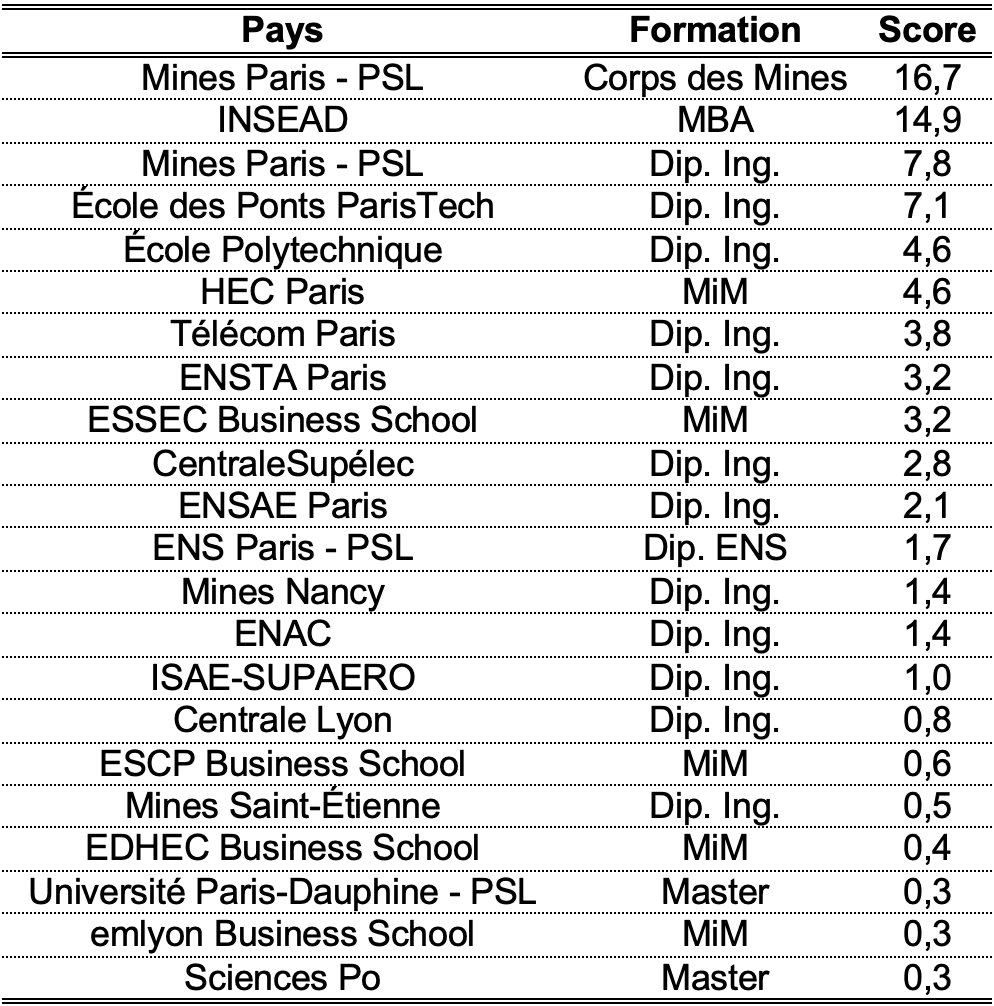
Source : Nombre d’associés issus d’une formation divisé par la taille d’une promotion de la formation uniquement pour les formations ayant diplômés plusieurs associés (exprimé pour cent étudiants).
Engineering schools tend to rank above business schools, even though a larger share of students at the top business schools aim for consulting careers (a share not taken into account in this study). More precisely, the most specialized, highly technical schools tend to rank above general ones. This is especially true of the Mines-Ponts exam schools, known for training highly technical engineers: all of them are ranked (except IMT Atlantique), and the specialized ones do particularly well: Mines Paris - PSL, École des Ponts ParisTech, Télécom Paris and ENSTA Paris.
The top 7 engineering degrees in this ranking are also among the 8 best engineering programs in France according to DAUR (https://www.daur-rankings.com/rankings/engineering_school/2022).
INSEAD is the leading program for strategy consulting in Europe by volume, but the Corps des Mines trains more partners relative to the size of its intake, without even being dedicated to consulting.